

Resilience of US Economy Poses Monetary Policy Dilemma for Emerging Markets in Asia
Kevin Du
2024-05-18The resilience of the US economy amid aggressive monetary policy tightening has caught many observers and economists off guard...
The resilience of the US economy amid aggressive monetary policy tightening has caught many observers and economists off guard. This unexpected strength, compounded by the sticky inflation in the US, presents a conundrum for policymakers around the world, who must grapple with the prospects of prolonged elevated interest rates in the US. This effect is particularly pronounced among emerging market (EM) economies, whose hands may be tied when managing their own monetary decisions as high rates continue to put pressure on their financial markets and currency valuations.
Despite concerns earlier last year that the US economy was headed for another recession, the economy continues to surpass expectations. The more-resilient-than-expected US economy led the International Monetary Fund (IMF) to revise its gross domestic product growth forecast for the country upwards over its last few World Economic Outlook (WEO) reports. In the latest WEO report for April 2024, the IMF projects the US economy to grow 2.7% this year, much higher than its earlier prediction of 1.1% in the April 2023 report.
One of the key factors contributing to the resilience of the US economy is that a notable proportion of households are shielded from the US Federal Reserve rate hikes because they have fixed-rate loans. When the Fed slashed interest rates to ultra-low levels during the pandemic, many borrowers had also already locked in the cheap fixed-rate loans. A study by the Federal Reserve Bank of St Louis found that around 40% of US households have mortgages, and of those, 92% have fixed-rate loans. Therefore, when the Fed started its aggressive rate hike cycle, many households were not faced with higher loan repayment obligations, effectively softening the impact of monetary policy tightening on the economy.
The US economy's robustness and persistently high inflation rate fuelled the narrative of a "higher-for-longer" policy rate stance. This outlook has implications that extend beyond the borders of the US. The more favourable interest rate differential for the US against EM economies affects investor appetite for EM assets, fund flows into their financial markets and the valuation of their currencies against the US dollar. This has also led many to be hesitant to lower their policy rates, even in the face of cooling inflation rates, as they are weary of the negative repercussions on financial fund flows and currency rates. For some countries, central banks even had to raise policy rates to support the currency. Case in point, Indonesia's central bank hiked rates by 25 basis points to 6.25% last month to shore up the weak rupiah.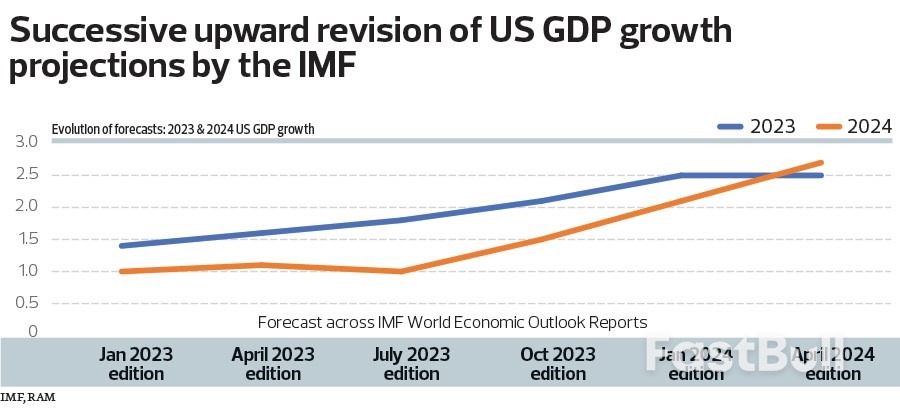
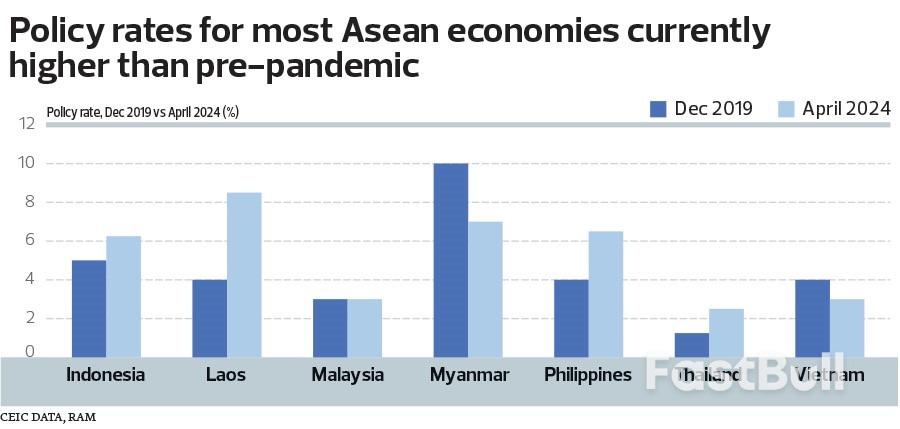 The "higher-for-longer" narrative presents a challenge to central bankers looking to ease the level of monetary tightness that was put in place over the last two years in response to inflationary pressures. Due to the tightening cycle embarked on to tackle the post-lockdown inflation spurt, policy rates for most Asean economies are currently sitting at a higher level than where they were pre-pandemic in 2019. Naturally, economies that went on a tightening cycle over the last two years would start to look at cutting rates soon to unwind some of the restrictiveness in monetary conditions as inflationary pressure eased. However, some economies might be hesitant to do so at this juncture because of the trade-offs and potential economic risks associated with easing monetary policy ahead of the Fed.
For Malaysia, the policy dilemma is not as acute, given that monetary policy currently is not overly restrictive, which reduces the need to cut rates to support the economy. Bank Negara Malaysia is an outlier among its regional peers in terms of its aggressiveness in hiking rates over the last two years given that Malaysia did not face as severe an inflationary pressure. For Malaysia, the main reason for the hike was to normalise interest rates back to the pre-pandemic level of 3%, as opposed to being on a tightening cycle like other Asean economies. The situation offers policymakers greater flexibility in navigating the evolving economic landscape.
Nevertheless, the monetary policy decisions of the US continue to be a significant topic for policymakers in Malaysia and other EMs in Asia. Any changes in the timing or scale of the US monetary policy have the potential to affect global financial markets, influencing exchange rates and capital flows in the region. As we navigate these uncertain times, it is crucial for policymakers to stay alert and flexible.
