

WTI TAS Explained: Why a Settlement Discount Does Not Lock In a Profit
 zhan chen
A TAS trade fixes a differential to a settlement price that is not yet known. Follow a one-contract WTI example from a $30 first-day credit to a $470 total loss, then compare fixed-price execution, fees and unmatched fills.
Buying WTI futures three cents below settlement sounds like an immediate bargain. It is only a bargain against one particular reference price. In a trade at settlement, or TAS, the parties agree the differential while the day's settlement price is still unknown. The absolute purchase price follows later. An attractive differential does not put a ceiling on that price, and a positive first-day cash adjustment does not protect the position after settlement.
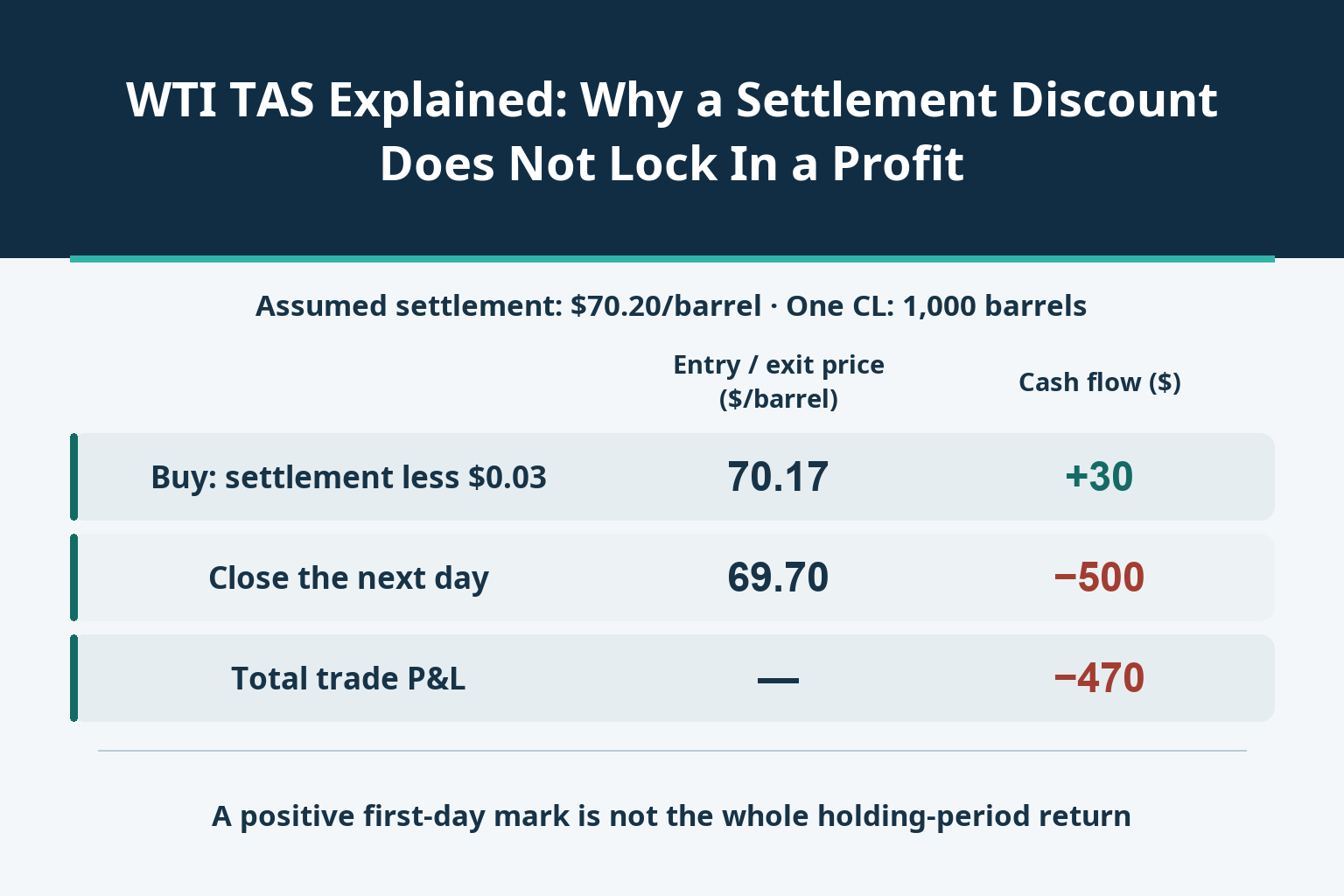
In the hypothetical example below, buying one standard CL contract at settlement minus $0.03 produces a $30 first-day credit. Closing the position at a lower price the following day nevertheless leaves a $470 loss overall. Both figures are correct: they describe different parts of the same cash ledger.
What the TAS fill actually fixes
Write the final assigned trade price as P = S + d, where S is the applicable day's settlement for the relevant futures month and d is the agreed dollar differential per barrel. A negative d lowers a buyer's price relative to S; a positive d raises it. For a seller the preference reverses: a higher differential produces a higher selling price, other things equal.
CME's Rule 524 framework distinguishes this settlement reference from the marker used in a trade at marker. TAS is not simply a market order submitted near the close, and S is not a promise to use the last trade on a chart. The calculation of the actual settlement is a separate process, explained in how WTI futures settlement prices are determined.
This example uses the standard NYMEX CL contract: 1,000 barrels and a $0.01-per-barrel minimum price increment, worth $10 per contract. Thus minus three ticks is minus $0.03 per barrel, not minus 3%, minus $3 per barrel or a negative absolute oil price. A front end may display ticks or a dollar differential; verify which field you are reading. The multiplier must not be carried over to a different-sized oil contract.
Reconcile the $30 credit with the $470 loss
Assume no opening position, a permitted TAS contract month and trading day, and a completed purchase of one contract at d = −$0.03. All prices here are invented teaching inputs, not live quotes. When the applicable settlement is determined as $70.20, the assigned purchase price becomes $70.17.
The first day's mark from $70.17 to $70.20 is positive $0.03 × 1,000 = $30. Now assume the contract is sold the following day at $69.70. The next cash adjustment measures the move from the previous $70.20 settlement to that exit, not from the original purchase again: ($69.70 − $70.20) × 1,000 = −$500.
| Cash-flow stage | Calculation | Cash flow ($) |
|---|---|---|
| First day's mark | (70.20 − 70.17) × 1,000 | +30 |
| Next-day exit | (69.70 − 70.20) × 1,000 | −500 |
| Whole trade | 30 − 500 | −470 |
The two cash amounts sum to −$470, exactly the same as ($69.70 − $70.17) × 1,000. Counting the $30 credit and then using the original entry price to calculate the second cash adjustment would count the first gain twice. Equally, reporting only the later $500 debit would omit an earlier credit. Reconcile the ledger across the entire trade.
Fees, taxes and the cost of funding margin are excluded from this initial ledger. Margin posted to support the position is also not the full invoice for 1,000 barrels of physical oil. A positive first-day mark can coexist with a substantial margin requirement and with later adverse cash calls.
Is TAS cheaper than buying at a fixed $70?
Consider two alternative, fully filled ways of acquiring the same one-contract exposure: buy outright at a fixed $70.00, or buy TAS at S − $0.03. They are counterfactual execution choices, not an assumption that both orders can be filled on demand at the same time. Before costs, TAS is cheaper only when S − $0.03 < $70.00, or S < $70.03.
| Scenario | Assumed settlement ($/barrel) | TAS buy price ($/barrel) | Saving against a $70 fixed buy ($) |
|---|---|---|---|
| Lower settlement | 69.90 | 69.87 | +130 |
| Equal price before fees | 70.03 | 70.00 | 0 |
| Higher settlement | 70.20 | 70.17 | −170 |
The table's saving is fixed-price cost minus TAS cost, multiplied by 1,000 barrels. A negative saving means TAS was dearer. This is a price-equivalent execution comparison, not a claim that either futures buyer pays the full price of 1,000 barrels upfront. At a $70.20 settlement, an apparently favorable three-cent differential still results in a $70.17 entry, $170 more expensive than the hypothetical fixed-price alternative.
This comparison cannot be completed from the differential alone while S is unknown. A trader choosing TAS is accepting exposure to the future settlement level in exchange for specifying the differential to that level. A fixed-price order instead specifies an absolute price, but may not fill. Neither order type simultaneously guarantees price, quantity and execution.
A small fee difference changes the break-even point
Add separate hypothetical all-in execution fees of $5 for TAS and $2 for the fixed-price alternative. TAS is strictly cheaper when 1,000 × (S − 0.03) + 5 < 1,000 × 70 + 2. The algebraic boundary is S < $70.027.
That is a comparison threshold, not an executable three-decimal settlement quote. If the relevant settlement lies on a one-cent grid, $70.02 is the highest grid price at which TAS is cheaper under these assumptions. At $70.03 the underlying entry prices are equal, but TAS costs $3 more in fees. Rounding $70.027 up to $70.03 and calling it a profitable cutoff would reverse the result at that boundary.
The fee inputs are deliberately hypothetical, not a published exchange or broker tariff. For an actual comparison, use costs for the same account, size and route, and include any material differences in financing and execution. A calculation with equal fill assumptions cannot establish the cost of an order that was rejected or only partly executed.
When the unknown settlement cancels—and when it does not
Suppose a separate example contains one TAS buy at S − $0.03 and one TAS sale at S + $0.02, both for the same month and day, with exactly the same eventual settlement reference. If both trades are filled in equal quantity, their gross difference is $0.05 per barrel, or $50 per paired contract. The S terms cancel algebraically.
This is an explanation of matched cash flows, not a claim that such a two-sided opportunity is available or risk-free to execute. Quotes, queue position, costs and fill uncertainty remain. If two buy contracts fill but only one sale does, only one pair cancels. With the other long entered at $70.17 and later closed at $69.70, that unmatched contract loses $470. Adding the paired $50 gives a $420 gross loss across the three TAS fills and the later closing trade.
The cancellation also fails if the references differ. A purchase tied to today's settlement and a sale tied to tomorrow's settlement leave tomorrow's S minus today's S in the result. Different delivery months leave a calendar-spread exposure. The word TAS on both tickets is not proof that the two unknown prices are identical.
Eligibility and position obligations do not disappear
A contract's ordinary futures session is not necessarily its TAS session. Rule 524 assigns eligible products, months and time windows to exchange rules and tables. Check the actual instrument and trading date before submitting an order; a past month's eligibility or a historical timetable is not sufficient. This article does not assert that a specific live contract is available for TAS at the moment it is read.
Once the price is assigned, TAS is not a separate protection against losses in the underlying futures position. Standard CL also remains a physically deliverable contract. Using TAS to enter it does not turn it into a cash-settled product or remove the need to manage expiry. Manipulating the underlying market to influence a settlement-linked position is not a legitimate way to obtain the differential.
A practical ticket-to-cash check
- Record the exact product, contract month, trading date, side, filled quantity and permitted TAS session. Distinguish the order sent from the quantity actually executed.
- Convert the displayed differential into dollars per barrel using the correct tick size. Keep the unknown settlement reference separate from the known differential.
- After settlement is available, reconstruct S + d and compare it with the assigned fill price. Verify that the same day's settlement and the correct month were used.
- Reconcile each day's cash adjustment once, then sum the trade through its actual exit. Add the appropriate fees and funding costs separately.
- When comparing an outright order or claiming matched exposure, check fill assumptions, quantities and reference dates. An unmatched contract or a different settlement reference must remain in the risk ledger.
TAS is useful when the settlement benchmark itself is part of the execution objective. Its advantage is precision about the differential, not certainty about the future level of oil prices. The right question is therefore not “Did I buy below settlement?” but “Which price was fixed, which exposure remained, and what did the complete cash ledger show?”


