

MBS Monthly Payments Are Not All Income: Reconcile Principal, Interest and Return
 zhan chen
An $8,400 MBS payment can contain only $400 of interest. Use pool factors to rebuild three distributions, reconcile the purchase cost and see why receiving principal early is not the same as earning a higher return.
An $8,400 credit to an investment account need not mean $8,400 has been earned. Suppose a mortgage-backed security has $100,000 of original face value and its pool factor falls from 0.80 to 0.72. Of that payment, $8,000 is principal coming back. With the assumed 6% security coupon, the other $400 is the interest payment. Only $72,000 of principal remains to support the next payment.
The useful reconciliation connects original face, current principal, cash distributions and the amount paid to buy the position. Original face does not shrink on the account's description simply because some principal has been returned. Conversely, protection of contractual principal payments is not a promise that the investor will recover every dollar of a secondary-market purchase price.
Identify the cash-flow rights before using a pool factor
This example concerns a plain single-class mortgage pass-through that pays both principal and interest, using Freddie Mac UMBS/MBS terms as the reference. It is not a cash-flow model for a CMO tranche, an interest-only or principal-only strip, or a negative-amortization structure. Different payment priorities can make the same underlying mortgages produce different investor cash flows.
Use the security's coupon, not the homeowners' mortgage rate. Servicing and guarantee arrangements can separate the two. The 6% below is an assumed annual coupon on the security, not a reported weighted-average rate on a real mortgage pool. A rate visible in a loan-level report is not automatically the right rate for reconciling the investor's payment.
Also distinguish a reporting month from a payment date, a factor-publication date and an interest-accrual period. Obtain the security identifier, original face held, relevant factors and entitlement to each distribution. A newly published factor does not mean cash has already arrived, and buying a position does not automatically entitle the buyer to every payment associated with that month.
Reconstruct the three payments from the original face
Let original face be N, and let the relevant factors before and after a payment be F₀ and F₁. For this structure, principal returned is N×(F₀−F₁); principal remaining is N×F₁. Monthly interest uses the applicable annual security coupon divided by 12, multiplied by principal immediately before the payment.
The original-face multiplier is important. A fall from 0.80 to 0.72 is eight percentage points of original face, but returns 10% of the $80,000 then outstanding. Neither description is an investment return. Multiplying a factor by a balance that has already been reduced by a factor can also understate the position.
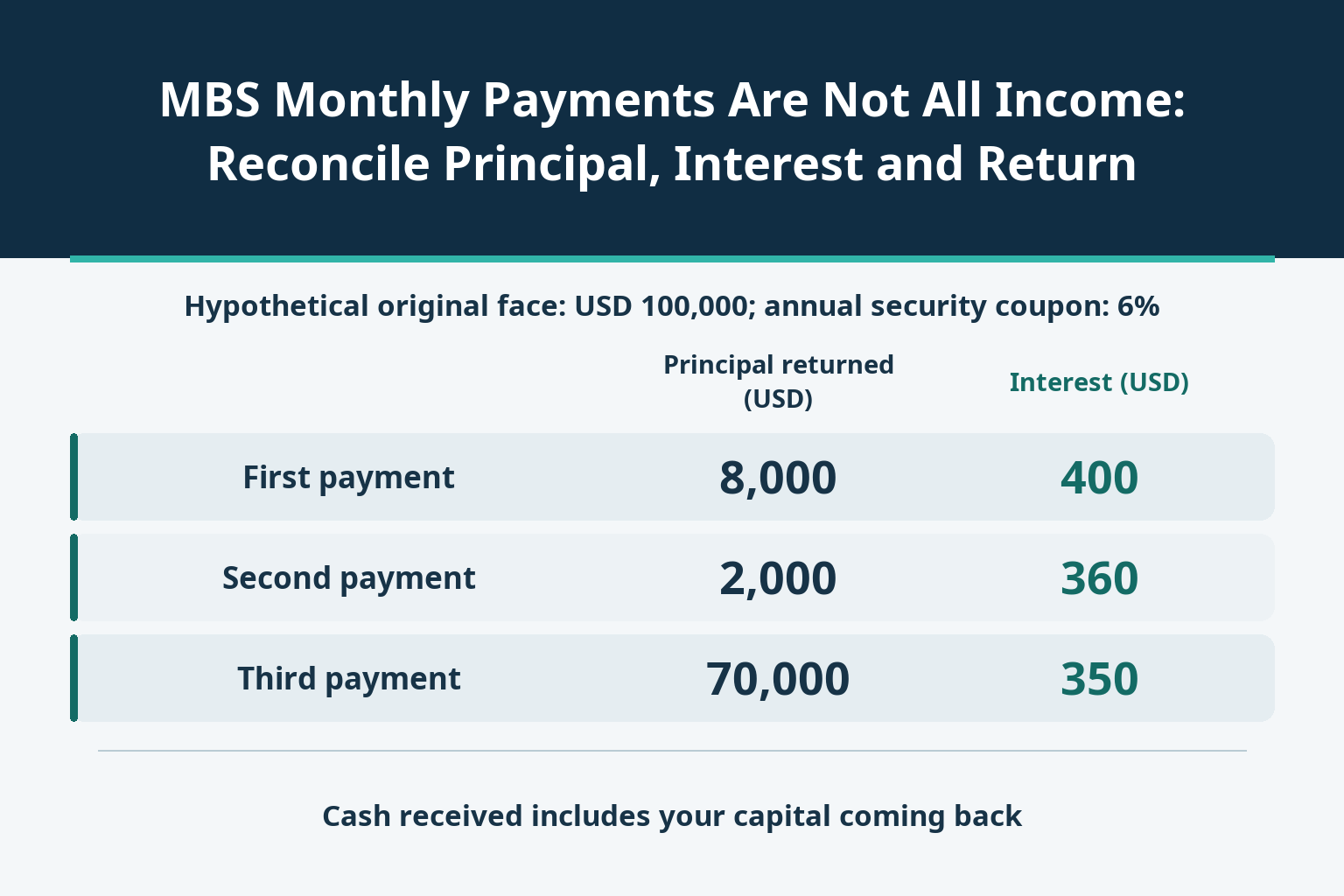
Assume original face of $100,000, opening outstanding principal of $80,000 and a 6% annual coupon. The buyer pays an all-in $82,000, including accrued interest and settlement adjustments, and owns all three distributions shown below. This specifies the cash rights without pretending the acquisition date must be the start of an accrual month. It is an invented payoff path, not a forecast for an actual security.
| Payment | Factor before → after | Principal returned (USD) | Interest (USD) | Total cash (USD) | Principal remaining (USD) |
|---|---|---|---|---|---|
| First payment | 0.80 → 0.72 | 8,000 | 400 | 8,400 | 72,000 |
| Second payment | 0.72 → 0.70 | 2,000 | 360 | 2,360 | 70,000 |
| Third payment | 0.70 → 0.00 | 70,000 | 350 | 70,350 | 0 |
The principal column adds to $80,000, exactly the opening balance; interest adds to $1,110. After the third payment the factor is zero, so no residual principal remains to sell or redeem. Adding another $100,000 maturity payment would count capital that has already been repaid. The factor changes alone do not tell us how much was scheduled amortization, voluntary prepayment or another permitted principal adjustment.
Why large distributions can still leave an $890 loss
Total cash received is $81,110 against an initial $82,000 outlay. With no other receipts, additional costs or taxes, the completed path produces a nominal loss of $890, or about 1.0854% of the outlay. This is a holding-period cash return for the specified path, not an annual yield or the return earned in one distribution month.
Of the receipts, $80,000 returns principal and $1,110 is interest cash. The $2,000 by which the all-in cost exceeds opening principal must be recovered through interest or other proceeds before the investor breaks even. Because that outlay includes accrued interest and settlement adjustments, the entire $2,000 must not be labelled a clean-price premium or a tax premium without further allocation.
Dividing the first $8,400 receipt by $80,000 gives 10.5%; mechanically multiplying by 12 gives 126%. Those are distribution-to-principal calculations, not investment yields. Even $400/$80,000×12=6% simply reproduces the assumed coupon arithmetic. It does not calculate the final return on the $82,000 actually paid.
A dated comparison requires the actual settlement and receipt dates, complete outflows and inflows, and explicit treatment of reinvestment. The distinction between cash-flow internal rate of return and realized wealth return matters here. No real dates are supplied in this example, so annualizing its result would introduce precision the inputs do not support.
Earlier principal means a different interest timeline
Consider a mutually exclusive path with the same $82,000 cost: all $80,000 of outstanding principal is returned at the first payment, together with $400 of interest calculated on the pre-payment balance. Total receipts are then $80,400. The loss is $1,600, approximately 1.9512% of the outlay.
| Separate payoff path | Total principal (USD) | Total interest (USD) | Total cash (USD) | Profit versus 82,000 outlay (USD) |
|---|---|---|---|---|
| Full payoff at first payment | 80,000 | 400 | 80,400 | −1,600 |
| Full payoff at third payment | 80,000 | 1,110 | 81,110 | −890 |
Compared with the path completed over three payments, the investor receives $710 less. That is precisely the $360 and $350 of later interest that no longer arrive. Earlier return of principal and a higher investment return are not synonyms. When the total cost is above outstanding principal, a shorter collection period can leave less interest available to recover that excess.
Nor does this prove that prepayment is always harmful. At an alternative all-in purchase cost of $78,000, the same three-payment total of $81,110 gives a $3,110 gain, approximately 3.9872%. Purchase price, timing and the opportunities for reinvesting returned cash all matter. The two payoff paths are illustrative alternatives, and the lower-price case is a separate cost assumption—not three predictions or a guarantee from buying below principal.
A lower factor does not identify the economic cause
Refinancing can accelerate repayment, but it is not the only source. A property sale, an extra principal payment or an applicable loan repurchase can affect the amount returned. To explain the change, reconcile scheduled principal, unscheduled principal and relevant removals or adjustments. A monthly factor series cannot by itself establish that interest rates fell or borrower credit quality improved.
A factor is also not a price quote. A factor of 0.70 gives $70,000 outstanding on the original $100,000 face, not a guaranteed $70,000 liquidation value. The remaining security has its own price, accrued interest and payment entitlements. Its market value can fall while principal distributions continue to arrive.
The stated final maturity does not tell us how long every dollar stays invested. Different principal-payment paths produce different weighted-average lives. Estimating all future interest by multiplying the original face, coupon and years to final maturity ignores the declining balance that drives this ledger. A maturity label is no substitute for an assumed or observed principal schedule.
Before full payoff, include the asset still held
Once the entire balance is repaid, receipts can be compared directly with the initial cost. Before then, counting distributions alone omits the residual asset. Subtracting the full purchase cost from those receipts can exaggerate a loss; calling returned principal profit while retaining the old asset value can overstate wealth. Both errors lose the connection between the cash account and the shrinking security position.
A workable reconciliation starts with realizable remaining-position value plus cash received that has not already been counted elsewhere, less the full original outlay. If the position value is a clean-price amount, account separately for accrued interest and other valid receivables. If it already includes those items, do not add them again. Trading fees, financing, taxes and reinvestment cash flows need their own entries.
A payment guarantee does not remove that accounting requirement. The Freddie Mac guarantee referenced here is not direct US Treasury debt, and it is not a guarantee of the buyer's purchase price, resale value or return. Likewise, a plain pass-through calculation cannot be carried unchanged into a structured class with different payment priorities.
Five checks for the next distribution
- Confirm the security identifier and structure: principal-and-interest pass-through or something with different payment rights and priorities.
- Match original face held with the two applicable factors. Do not apply another factor to an already factored balance.
- Recalculate returned principal from the factor change, and interest from pre-payment principal and the security coupon; compare each with the statement.
- Check distribution entitlement, reporting period and actual receipt date. Separate scheduled repayment, prepayment and other adjustments where the records allow.
- Reconcile the all-in purchase cost, non-duplicated cash and remaining asset value. Use complete dated flows before comparing annualized returns.
The key question is not how much the account received this month. It is how much was capital coming back, what asset remains, and whether the complete cash flows cover the actual purchase cost. The pool factor helps rebuild that account; it is not a stand-alone yield.


