

USD/HKD’s Peg: Why the 7.75–7.85 Band Does Not Guarantee a Trading Profit
 Eva Chen
Hong Kong’s currency board links the exchange rate to bank liquidity, not to a trader’s target return. Follow a hypothetical convertibility transaction through the Aggregate Balance, then calculate how a small move inside the band can still produce a substantial account loss.
A narrow exchange-rate band is not a trading strategy. USD/HKD can stay within 7.75–7.85 while a position loses money, financing eats into a gain or an account runs short of collateral. The peg describes a monetary framework; it does not promise a particular entry price, exit date or return on the money in a trading account.
To judge a proposed trade, keep two calculations separate. One explains how the Hong Kong Monetary Authority’s currency transactions affect bank settlement balances. The other uses your actual position size, execution prices and costs. Confusing the two turns a stabilising mechanism into a profit guarantee it does not provide.
First read the quote in the right direction
USD/HKD is the number of Hong Kong dollars per US dollar. A fall from 7.8000 to 7.7800 means the Hong Kong dollar has strengthened: fewer Hong Kong dollars buy one US dollar. A long USD/HKD position is long US dollars against Hong Kong dollars, so that fall works against it.
The HKMA describes the Linked Exchange Rate System as a currency board that maintains the exchange rate within 7.75–7.85. At the strong-side Convertibility Undertaking, it buys US dollars from licensed banks at 7.75; at the weak side, it sells US dollars at 7.85. Strong and weak refer to the Hong Kong dollar, not to whether the USD/HKD chart is rising.
These are bank-level conversion arrangements. They are not two prices at which every retail customer can instantly trade either way. Nor does the linked rate of 7.80 mean that every market transaction must occur there. A customer’s executable bid and ask, contract terms and permitted transaction size still have to be checked.
Track what a convertibility transaction adds or removes
The Aggregate Balance is the sum of balances in banks’ clearing accounts with the HKMA. It is part of the Monetary Base, not the total of customer deposits or the balance in an individual trading account. This distinction matters when a headline describes liquidity being added or withdrawn.
Start with a purely hypothetical Aggregate Balance of HKD 50.00 billion. Compare two separate, fully settled transactions of USD 1.00 billion, holding every other flow at zero. The rows below are alternatives, not a sequence and not observations from a particular day.
| Independent settled scenario | HKMA’s USD transaction, bn | HKD balance change, bn | Ending Aggregate Balance, HKD bn |
|---|---|---|---|
| No transaction | 0.00 | 0.00 | 50.00 |
| Strong-side undertaking, 7.75 | Buys 1.00 | +7.75 | 57.75 |
| Weak-side undertaking, 7.85 | Sells 1.00 | −7.85 | 42.15 |
At the strong side, 1.00×7.75 = HKD 7.75 billion is credited to bank settlement balances, so the model total becomes 57.75. At the weak side, HKD 7.85 billion is removed in exchange for USD 1.00 billion, leaving 42.15. Both rows begin at 50.00; subtracting one ending balance from the other does not measure an actual day’s net operation.
The two undertaking rates are not an instant round-trip profit. At 7.75 the bank gives up dollars and receives Hong Kong dollars; at 7.85 it pays more Hong Kong dollars per dollar received. In addition, the scenarios represent different sides of the mechanism, not simultaneous offers to a retail trader.
For a real reconciliation, distinguish a forecast settlement change from an already settled balance. Other items, including Exchange Fund paper transactions and interest payments, can also affect the reported Aggregate Balance. An observed daily change alone cannot establish the size of a convertibility operation.
Interest-rate adjustment has a direction, not a guaranteed timetable
The HKMA’s explanation connects strong-side purchases of US dollars with an expanding Aggregate Balance and downward pressure on Hong Kong dollar interest rates. Weak-side sales of US dollars contract that balance and put upward pressure on Hong Kong dollar rates. Those changing monetary conditions help move the exchange rate back into the convertibility zone.
This is a transmission mechanism, not a rule that a certain number of dollars changes a particular interest rate by a fixed number of basis points. The accounting table contains no interest-rate forecast. It cannot tell a trader how many days a position must be held, whether a selected market rate will move immediately or when USD/HKD will reach 7.80.
It also does not make two retail financing charges identical to the policy-rate difference. A projected carry gain requires the product’s own applicable charges, holding dates and cash-flow convention. A spot quote near an undertaking level, by itself, supplies none of those inputs.
A move inside the band can still take 10% of account equity
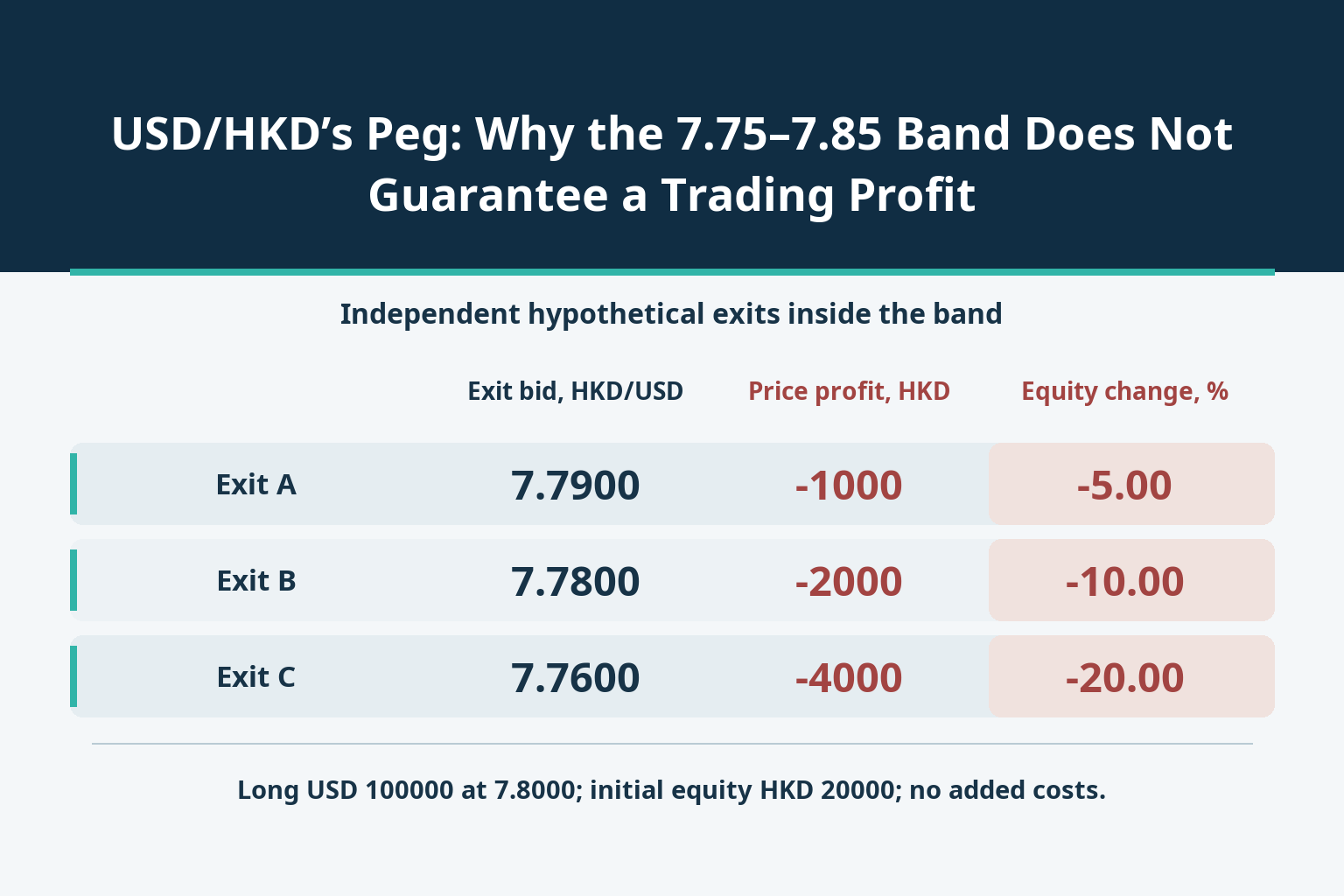
Consider a hypothetical linear USD/HKD position with profit measured in Hong Kong dollars. Buy N = 100000 US dollars at an actual ask K = 7.8000. Initial account equity E₀ is HKD 20000, with no other positions or cash flows. For each independent exit below, assume the whole position can be sold at the stated actual bid B. Ignore additional commissions and financing for now.
Gross price profit is P = N×(B−K). The percentage in the last column is P/E₀, not the percentage change in USD/HKD and not a margin requirement.
| Actual exit bid, HKD/USD | Gross price profit, HKD | Equity after price result, HKD | Change from initial equity, % |
|---|---|---|---|
| 7.7900 | −1000 | 19000 | −5.00 |
| 7.7800 | −2000 | 18000 | −10.00 |
| 7.7600 | −4000 | 16000 | −20.00 |
At 7.7800, P = 100000×(7.7800−7.8000) = −2000 HKD. Equity after that price loss is 18000, a 10% decline from 20000, even though the quote remains comfortably inside the convertibility zone. The assumed opening notional is 780000 HKD, or 39 times initial equity. That exposure ratio explains why a small currency move can have a much larger effect on account equity; it is not a statement that this leverage is available or suitable for any particular customer.
The table is neither a worst-case bound nor a stop-out forecast. It assumes the specified exits actually occur and has no margin rule. Whether a position survives until an intended exit requires a separate check of collateral requirements and the account’s liquidation terms. See the difference between account balance, equity and margin level. Replacing equity with a positive cash balance would not answer that question.
Bid and ask matter even before a directional move. If the entry quote is 7.7990/7.8000 and it is unchanged when the long is immediately sold, the price result is 100000×(7.7990−7.8000) = −100 HKD. That spread is already in the two execution prices; deducting it again would double count the same cost.
A profitable price move and a profitable holding period are different tests
Add a separate, invented cash ledger to the 7.7800 exit: a financing credit of HKD 120 for the entire holding period and total additional commissions of HKD 80. The net result is −2000 + 120 − 80 = −1960 HKD. The credit reduces the loss; it does not reverse it. These amounts are calculation inputs, not current financing quotes.
If a trade is planned to earn interest while waiting for the exchange rate to reverse, write down the price result and the dated financing entries separately. Confirm the direction of each charge, the number of days covered, the currency in which it is booked and whether the displayed profit already includes it. A quoted annual rate cannot simply be added to a one-day price return.
Likewise, a cash conversion, an interest-bearing currency deposit and a leveraged linear position are different products. The position formula used here does not replace a delivered-currency cash ledger or a deposit’s interest terms. The peg does not make their costs, access to funds or collateral treatment interchangeable.
Verify the mechanism, the evidence and the trade separately
For the monetary framework, confirm the current undertaking rates and which party buys each currency. If interpreting an actual HKMA operation, match its amount and settlement date to the corresponding Aggregate Balance data, then account for other reported changes. A retail chart touching a level is not, by itself, confirmation of a particular bank transaction.
For the proposed position, record the product, base-currency units, actual entry side, executable exit side and account currency. Recalculate price profit before adding each financing or commission entry once. If the account is not denominated in Hong Kong dollars, the translation into account currency needs its own documented conversion rate and convention.
Finally test whether the account can bear an adverse move before any expected reversal. Use actual equity and applicable margin terms, not the distance to a band edge as a substitute for an account-level limit. If a claimed return depends on an unavailable execution price, an assumed financing credit or an unspecified holding period, the claimed return has not been established.


