

Forex Swap Charges: Check Points, Rollover Multipliers and Net Profit
 Patrick Turner
Rebuild a forex financing charge from its unit, position size and rollover schedule. A worked example separates four rollover events from six charging units and converts the full cost into a price-move hurdle.
Four overnight rollovers do not necessarily mean four equal financing charges. A schedule with multipliers of 1, 3, 1 and 1 produces six charging units. Whether a displayed swap rate is in quote points, pips or money per lot matters just as much as the number itself.
The practical task is to reproduce the account debit before deciding how much of a profitable price move remains. The example below uses invented EUR/USD terms, not a current market rate or a universal broker schedule.
Read the unit before multiplying the rate
Assume a USD account holds 0.40 lots of EUR/USD, with 100,000 EUR per lot. A quote point is 0.00001 USD per EUR; a standard pip is 0.0001. Thus one quote point is worth 0.40 USD for this position and one pip is worth 4 USD. These definitions are inputs, not a rule that every instrument uses the same precision.
Suppose the long-side rate is −6.5 quote points per lot for one basic charging day. The position debit is −6.5×0.00001×100,000×0.40=−2.60 USD. The following three quotations are deliberately equivalent under these exact assumptions.
| Displayed unit | Hypothetical quotation | 0.40-lot base charge, USD |
|---|---|---|
| Quote points | −6.5 | −2.60 |
| Standard pips | −0.65 | −2.60 |
| USD per lot | −6.50 | −2.60 |
A point is not automatically a pip. Reading −6.5 quote points as −6.5 pips would overstate this cost tenfold. Conversely, a money rate stated per lot is multiplied by the lots, not by the 100,000 contract size again. A rate already expressed for the whole position must not be multiplied by the lots a second time.
Count the charging weights, not just the nights
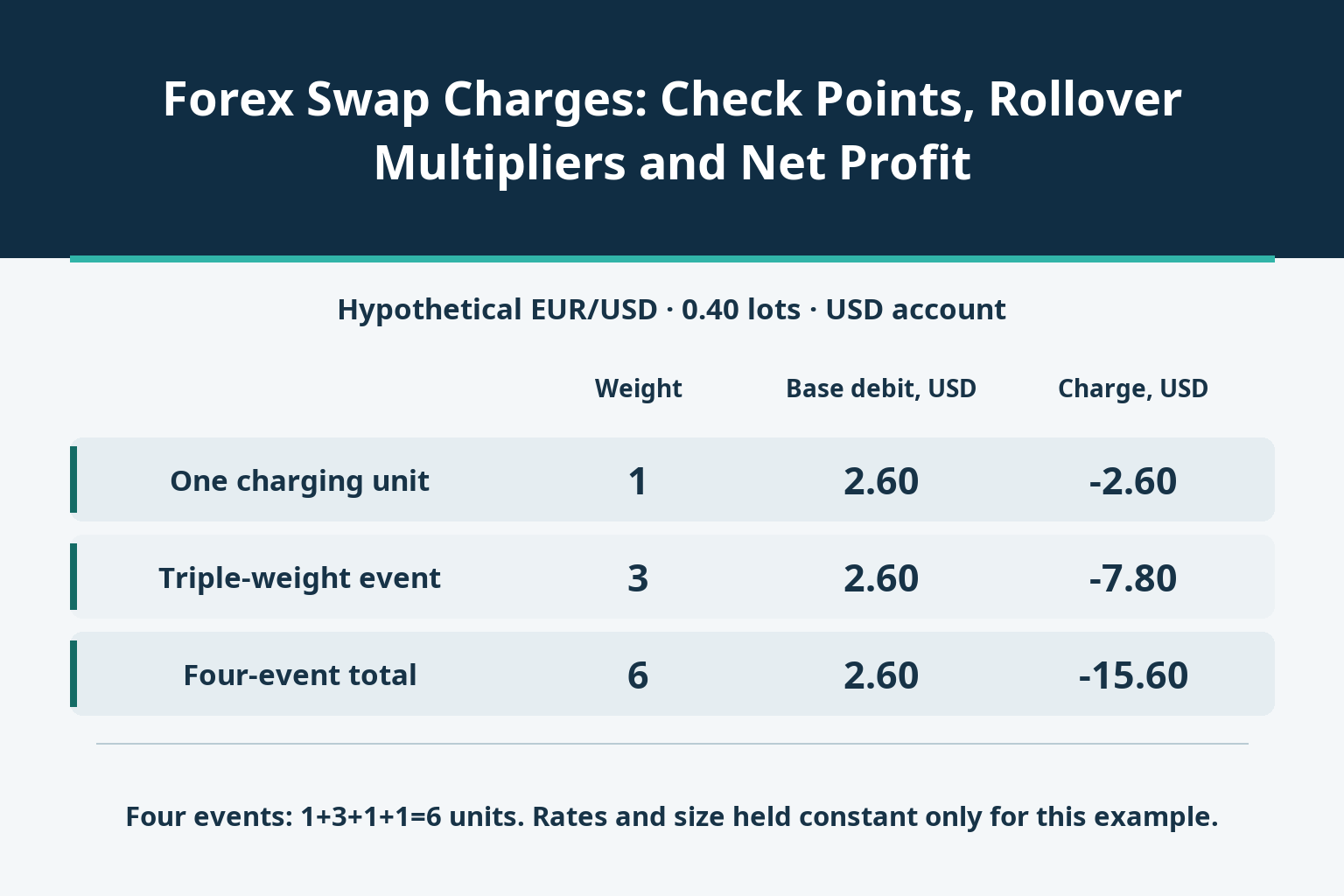
Hold the rate and position constant for four hypothetical rollover events. Their published multipliers are 1, 3, 1 and 1. A multiplier of three changes one base debit of 2.60 USD into 7.80 USD; it does not mean the displayed position has suddenly tripled.
| Rollover event | Multiplier | Charge, USD |
|---|---|---|
| 1 | 1 | −2.60 |
| 2 | 3 | −7.80 |
| 3 | 1 | −2.60 |
| 4 | 1 | −2.60 |
The financing total is −15.60 USD. Multiplying −2.60 by four instead gives −10.40 and misses 5.20 USD. If rates or quantities change, calculate each event separately: financing equals the sum of position lots at that event × the effective per-lot amount × that event’s multiplier. Do not apply today’s rate retrospectively to the entire holding period.
A price profit is not the net account result
Assume actual entry and exit execution prices produce an 8-pip profit. At 4 USD per pip, price profit is 32 USD. With financing of −15.60 and a separately charged 2.80 USD round-trip commission, the net result is 32−15.60−2.80=13.60 USD. The price move earned money, but more than half of that price profit was consumed by the two specified costs.
Because actual execution prices were used, their bid–ask spread effect is already in the price profit. Do not subtract another generic spread estimate. Conversely, if a backtest starts from midpoint prices rather than executable prices, its execution-cost treatment needs its own reconciliation.
If entry and exit execution prices were identical, the example would lose 18.40 USD from financing and commission. Covering those two costs requires 18.40÷4=4.60 pips, assuming the same size, schedule and charges. That is an accounting break-even, not a forecast, an assured fill or a recommended exit. A longer holding period or changed rate moves the hurdle.
Why “Wednesday triple swap” is not a complete rule
A product may use a larger multiplier on a particular rollover to account for its settlement schedule, but the label Wednesday is not enough to reconstruct a statement. Read the actual product’s day-by-day settings and agreement, including holiday adjustments and the relevant server-time cutoff. This example does not assign its four events to any real calendar dates.
A brief position that crosses a qualifying cutoff can incur financing while a longer intraday trade that closes before it may not, if those are the account’s terms. Local midnight and the trading server’s rollover need not coincide. Daylight-saving changes, currency holidays and product-specific rules must be checked rather than guessed.
A weekend is not an instruction to add two more charges after a three-unit event that already incorporates those days. Establish what the multiplier covers before adding anything. Percentage-based or close-and-reopen financing methods also require their own contract formula; the points example does not price them.
The central-bank rate gap is not your account’s swap quote
A policy-rate differential can help explain financing conditions, but it does not by itself specify an executable retail debit or credit. The account’s applicable long and short quotations, adjustments and currency-conversion terms determine the cash amount. Do not assume reversing a position merely reverses the sign of an unchanged swap rate.
A positive financing entry does not make the overall trade profitable. Exchange-rate losses, execution prices, commissions and subsequent rate changes can exceed it. Annualising a single favourable night also assumes a rate and holding path that have not been secured. This article reconciles charges; it does not turn them into a guaranteed carry return.
A reconciliation that can be checked line by line
Retain the exact account and symbol specification, direction, contract size, unit definition, dated long/short rates, event multipliers, server time zone and rollover cutoff. Match the position quantity at each event, including partial closes and any contractual treatment of netted or offsetting positions.
Then reconcile each calculated amount with the statement’s financing entry, fee currency and conversion rate. Separate other administrative fees and commissions rather than silently adding them to swap. If the account uses another currency, convert under the applicable terms at the relevant event; today’s spot rate is not automatically the historical conversion.
Missing rate history or a holiday schedule means the charge remains unverified, not necessarily wrong. Ask for the dated inputs and calculation basis. Once the total cost is known, use position sizing from account risk and stop distance to put it in the same risk budget as the position’s exit distance. Avoid “fixing” an unexplained debit by simply increasing trade size.


