

Forex Margin Level: Why a Positive Balance Does Not Prevent Stop-Out
 James Riley
Balance is not the equity supporting an open forex position. Calculate margin level and the cash buffer to a stated stop-out threshold, then test how fees, higher margin requirements and a partial close change the result.
A forex account can show a positive balance and still meet its stop-out condition. The relevant calculation may be equity divided by used margin, not balance divided by margin. A rising margin requirement can worsen that ratio even without a fresh price loss.
Start with the account’s actual terms: a percentage threshold and a money-based threshold are not interchangeable. This worked example assumes a percentage mode, with the stop-out condition met at or below 50%. That percentage and its equality rule are invented inputs, not a universal market standard.
Separate balance, equity and free margin
Assume a USD account has a balance of 2,500 and floating trading losses of 1,400. With no credit, blocked funds or unposted fees in the example, equity is 2,500−1,400=1,100 USD. Used margin is a supplied account value of 2,000 USD; it is not inferred from an advertised leverage ratio.
Margin level=equity÷used margin×100=55%. Free margin=equity−used margin=−900 USD. The negative free margin can restrict additional trading under the account’s rules, but it is not the same number as a 50% stop-out threshold. Under the stated assumption, this baseline has not yet met that threshold.
Do not replace the numerator with the 2,500 balance: that would produce 125%, masking the floating loss. In a real account, credit, booked or blocked commissions and the treatment of floating gains may also affect the available fields. Reconcile the actual definitions before using a simplified equation.
Two different ways to cross the boundary
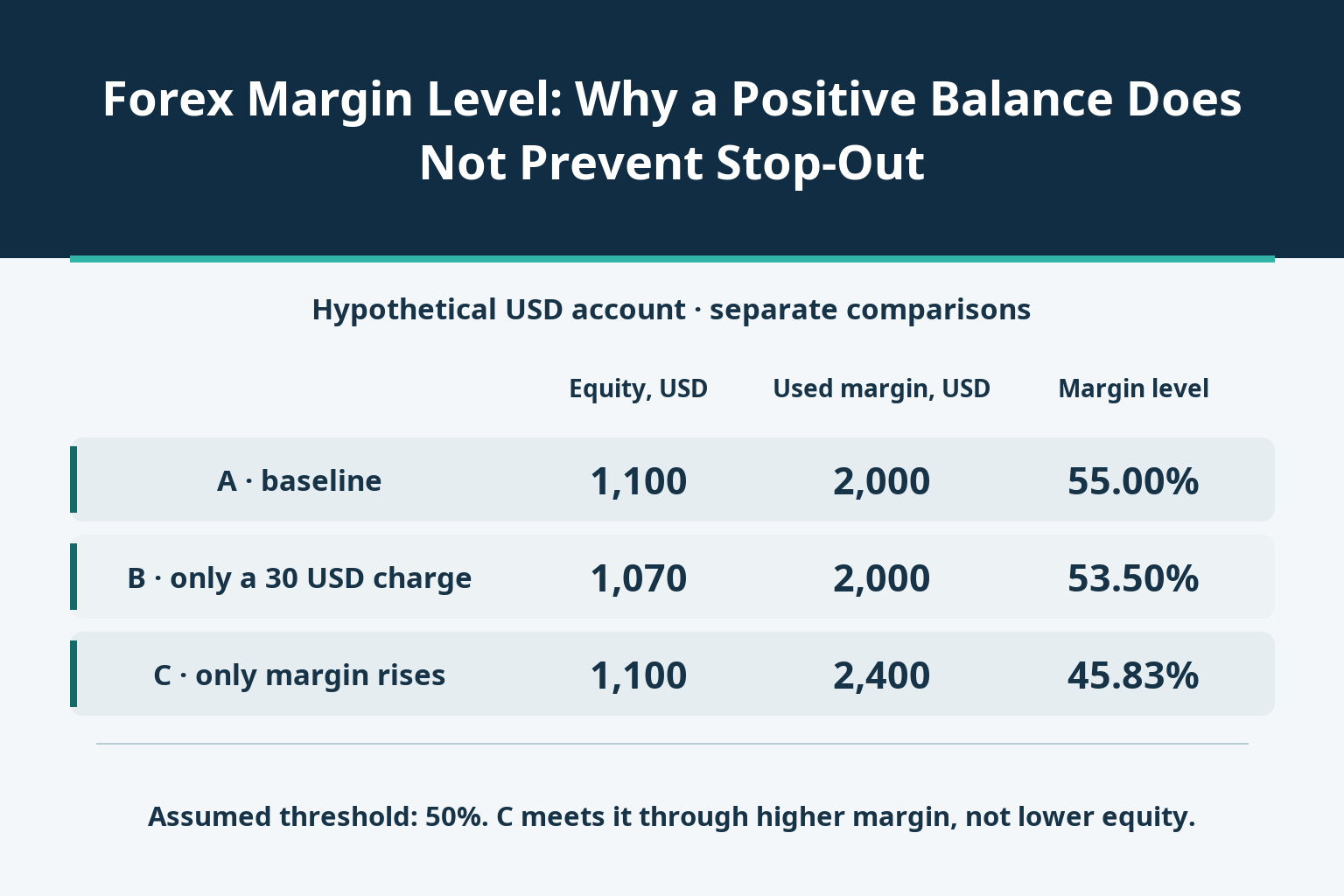
The table compares three separate states. B adds only a 30 USD posted charge to baseline A; C instead raises used margin to 2,400 with equity unchanged from A. B and C are not successive steps.
| Independent state | Equity, USD | Used margin, USD | Margin level | Buffer to 50%, USD |
|---|---|---|---|---|
| A · baseline | 1,100 | 2,000 | 55.00% | 100 |
| B · only a 30 USD charge | 1,070 | 2,000 | 53.50% | 70 |
| C · only margin rises | 1,100 | 2,400 | 45.83% | −100 |
For a threshold fraction s=0.50, boundary equity is s×used margin and the cash buffer is equity−s×used margin. A has a 100 USD buffer; B has 70. C has a buffer of −100, so it meets the assumed stop-out condition even though its equity did not fall relative to A.
This buffer is headroom against the assumed threshold, not free margin or cash available for withdrawal.
A margin call or a restriction on opening a new position can have a different trigger from forced closure. Check all applicable account conditions rather than treating 100% as a universal liquidation line. A zero used-margin denominator also cannot be interpreted through the same ratio.
A cash buffer is not a guaranteed number of safe pips
Suppose the only position is 100,000 EUR of EUR/USD in the USD account and one standard pip is 0.0001 USD per EUR. A pip is then worth 10 USD. The 70 USD buffer in B corresponds to seven additional adverse pips only if used margin stays at 2,000 and there are no other charges or changes in exposure.
That is a sensitivity calculation, not a promised liquidation price. Margin conversion, changed requirements, another position, financing, gaps and execution costs can change the result before or during closure. The ratio decides whether a stated condition is met; it does not guarantee when a trade can be filled or which position is closed first.
A pending stop-loss order does not override the account’s liquidation rules or guarantee its execution price. To investigate a closure, distinguish the stop-out event, the broker’s resulting orders and the actual fills.
A partial close can improve the ratio without creating equity
Return to A. Independently assume half the position is closed at its marked value, without an execution difference or fee, and that used margin releases in direct proportion to quantity. Half the floating loss, 700 USD, becomes realised. Balance falls to 1,800; the remaining floating loss is 700. Equity is still 1,100 USD.
| Independent partial-close comparison | Balance, USD | Floating P/L, USD | Equity, USD | Used margin, USD | Margin level |
|---|---|---|---|---|---|
| Before: A | 2,500 | −1,400 | 1,100 | 2,000 | 55.00% |
| After half close, no costs | 1,800 | −700 | 1,100 | 1,000 | 110.00% |
Used margin falls from 2,000 to 1,000, so margin level rises from 55% to 110% and free margin from −900 to 100 USD. The denominator shrank; the account did not earn 700 USD and the loss was not erased. Costs would reduce equity, while tiered or hedged-margin rules might prevent a proportional release.
This is an accounting comparison, not a forecast of an actual forced-close sequence. A broker may use different sizing, netting, offset and closure rules. Unwinding one side of an offsetting portfolio can even change margin requirements in a way that a simple half-size model misses.
Common “fixes” that change the wrong number
Watching balance alone ignores open losses. Assuming a higher leverage setting raises equity confuses collateral requirements with trading performance; an effective change may alter required margin, not erase losses. A deposit can add resources but is not investment profit, and its timing must be considered.
Likewise, realised losses after a partial close can make balance look worse while the margin ratio improves. Conversely, a smaller floating loss does not prove new wealth when that loss has merely moved into balance. Compare equity and margin at the same timestamp.
Do not count a fee twice if it has already reduced balance, or include a floating result again when the platform’s displayed equity already includes it. Mixing a pre-fee equity figure with a post-change margin requirement can invent a ratio the account never actually had.
Rebuild the closure from dated account records
Obtain the exact account mode, threshold units, boundary and equality rule, product margin formula, required-margin changes and their effective times. Match these with balance, floating P/L, equity, credit, blocked amounts, posted charges and used margin immediately around the event.
Then follow position quantities and the liquidation orders through to fills, with server timestamps and currency-conversion inputs where relevant. A later screenshot of balance or a price chart alone cannot reproduce the earlier account state. If key records are missing, describe the result as unresolved rather than declaring either an error or a valid liquidation.
Once the fields are reconciled, use position sizing from account risk and stop distance to distinguish the trade’s planned loss from the collateral threshold. A margin limit measures account funding capacity; it is not a substitute for a position-level risk budget.


