

Box Spread Financing: Calculate the Borrowing Rate After Fees
 zhan chen
A short box can exchange cash today for a fixed payment later. Rebuild the four option legs, calculate the rate on usable net proceeds and test whether fees or withdrawal restrictions erase the apparent saving.
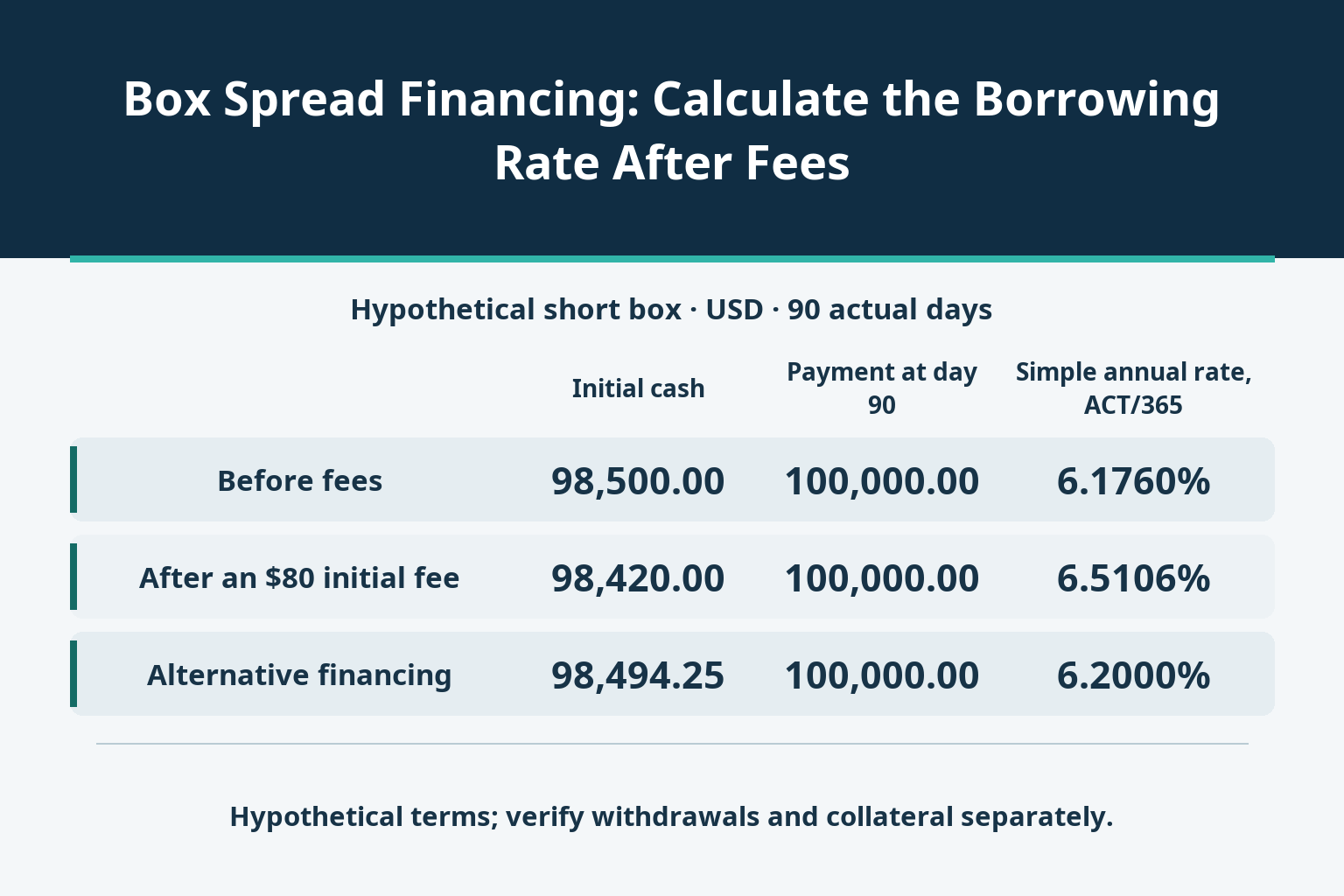
A short box that brings in $98,500 and pays out $100,000 ninety days later has an implied borrowing cost. It does not follow that the cost is attractive. In the hypothetical example below, an $80 initial fee raises the simple ACT/365 annual rate from about 6.1760% to 6.5106%, above a comparable 6.2% alternative.
The practical question is how much cash can actually be used, on what date, against which final obligation. A fixed option payoff answers only part of it. The financing comparison also needs execution costs, withdrawal permission and the cash demands of collateral.
Build the liability from the four legs
Assume one European, cash-settled index-option series with a $100 multiplier. Sell the 5,000 call, buy the 6,000 call, buy the 5,000 put and sell the 6,000 put, one contract each. All four legs share the expiry, exercise-settlement definition and final index value S. These are hypothetical strikes and prices, not a live SPX quote.
The table shows settlement cash, with money received positive and money paid negative. Premiums and fees are separate. Between the strikes, the short call pays −100(S−5,000) and the short put pays −100(6,000−S), totaling −$100,000. Below both strikes, the puts produce the same liability; above both, the calls do. The result follows from the payoff identity, not merely from three sample outcomes.
| Final index S | Short 5,000 call | Long 6,000 call | Long 5,000 put | Short 6,000 put | Net cash, USD |
|---|---|---|---|---|---|
| 4,500.00 | 0.00 | 0.00 | 50,000.00 | -150,000.00 | -100,000.00 |
| 5,500.00 | -50,000.00 | 0.00 | 0.00 | -50,000.00 | -100,000.00 |
| 6,500.00 | -150,000.00 | 50,000.00 | 0.00 | 0.00 | -100,000.00 |
Read the net credit as financing cash
Assume the complete package executes for a $98,500 net option credit. Total initial commissions and other modeled charges are $80, paid on the same day; there are no final charges or other cash movements in this example. Usable initial proceeds are therefore $98,420. The ninety-day period runs from actual receipt of those funds to the actual final payment, not automatically from the order date to the option-expiry label.
The final $100,000 includes repayment of the cash raised and the financing charge. Subtracting the option credit gives $1,500 before fees; using the cash after fees gives $1,580. Neither amount is an additional loss to add again after calculating the borrowing rate.
Calculate the rate on the money received
For initial proceeds P, final payment F and d actual days, the simple ACT/365 annual cost is (F/P − 1) × 365/d. Before fees: (100,000/98,500 − 1) × 365/90 ≈ 6.1760%. After the $80 fee: (100,000/98,420 − 1) × 365/90 ≈ 6.5106%.
Dividing $1,500 by the final $100,000 instead gives about 6.0833% annualized, a different denominator. It understates the borrowing rate measured on cash received. An effective annual calculation, (F/P)^(365/d) − 1, is another convention; do not compare it directly with a simple annual loan rate or assume the trade can be rolled at an unchanged rate.
| Financing case | Initial cash | Payment at day 90 | Simple annual rate, ACT/365 |
|---|---|---|---|
| Before fees | 98,500.00 | 100,000.00 | 6.1760% |
| After an $80 initial fee | 98,420.00 | 100,000.00 | 6.5106% |
| Alternative financing | 98,494.25 | 100,000.00 | 6.2000% |
Find the fee threshold before calling it cheaper
Suppose alternative financing uses the same cash dates and a simple ACT/365 rate of 6.2%. For a final payment of $100,000, it provides 100,000/(1 + 0.062 × 90/365) ≈ $98,494.25 initially. The box's pre-fee $98,500 credit exceeds this by only about $5.75. Total initial fees must be below $5.7477468 to retain a cost advantage; equality means equal cost.
At an $80 fee the advantage has reversed. Another way to compare equal borrowing amounts is to finance $98,420 at 6.2%: repayment would be about $99,924.61, versus the box's $100,000. The difference is about $75.39. These are alternative views of the same stipulated comparison, not two charges to add together.
Verify withdrawals and collateral separately
A premium credit in the account is not evidence that the broker permits an external withdrawal. Obtain the permitted cash amount, its availability date, the account's margin treatment and the applicable collateral terms. If the money cannot leave when required, the structure has not met the external funding need, regardless of its displayed rate.
The final liability can remain fixed while the assets supporting it fall in value. Additional collateral, a reduced lending value or forced position closure can create an earlier cash demand. The example does not quantify that demand or the opportunity cost of collateral. Its fee-adjusted rate includes only the stated costs and cannot be presented as a universal all-in borrowing cost.
Keep the contract and exit conditions intact
All legs must use the same relevant contract series and settlement value. Mixing morning- and afternoon-settled contracts, different expiries or American-style exercise changes the cash-flow structure. Entering separate legs also exposes execution prices and interim positions; use the executable price of the complete package for the financing comparison.
If the position must be closed early, obtain the executable package close-out price, new fees and the date collateral will be released. The fixed $100,000 expiry payment is not today's exit quote. The directional behavior of a bull call spread and its payoff limits is useful background, but adding a second spread creates a financing identity only when all contract terms match.
A compact funding check
Write down the four signed positions and prove the final cash obligation. Reconcile the executable option credit to actual net proceeds, then confirm the receipt and payment dates. Calculate both alternatives with the same annualization, cash amount and cost coverage. Finally test withdrawal access, collateral stress and an early exit. A small quoted-rate edge matters only if it survives all of these checks.


