

Binance’s $6.3 Billion Security Incident: A Possible DevOps Laptop Breach and the Limits of SAFU Protection
 Eva Chen
Binance puts the impact at about $6.3 billion and reports roughly $3 billion frozen. Its preliminary account points to a possible DevOps laptop compromise. What loss coverage, asset recovery and SAFU can—and cannot—establish.
Binance estimates that a security incident involving unauthorized withdrawals on October 29, 2026 affected approximately $6.3 billion in assets. The exchange says it has worked with blockchain partners to freeze around $3 billion and will cover all losses using its Secure Asset Fund for Users, known as SAFU, and company funds. Those figures describe the estimated impact and assets frozen; neither establishes the final net loss.
In an October 30 update, co-CEO Richard Teng said the initial investigation pointed to a potentially compromised DevOps engineer’s laptop. That may have allowed an attacker to access a service container and submit unauthorized withdrawal transactions. Binance says it has found no evidence of wallet private keys being leaked. The entry point and full attack sequence remain under investigation.

The distinction matters. A platform can lose control over how transactions are authorized even if an attacker does not obtain the private keys themselves. Equally, a promise to cover losses is not the same as evidence that a particular emergency fund can finance the entire amount on its own. The questions now are how the withdrawals passed internal controls, how much of the affected money can actually be returned, and how Binance will fund any remaining shortfall.
What Binance has disclosed
Binance says it temporarily suspended deposits and withdrawals while completing security checks, revoked the affected address authorization, and engaged law enforcement and blockchain intelligence partners to trace and recover funds. It says user funds are safe and has promised a detailed technical post-mortem once the investigation is complete and the facts are verified. An updated proof of reserves is expected after remediation.
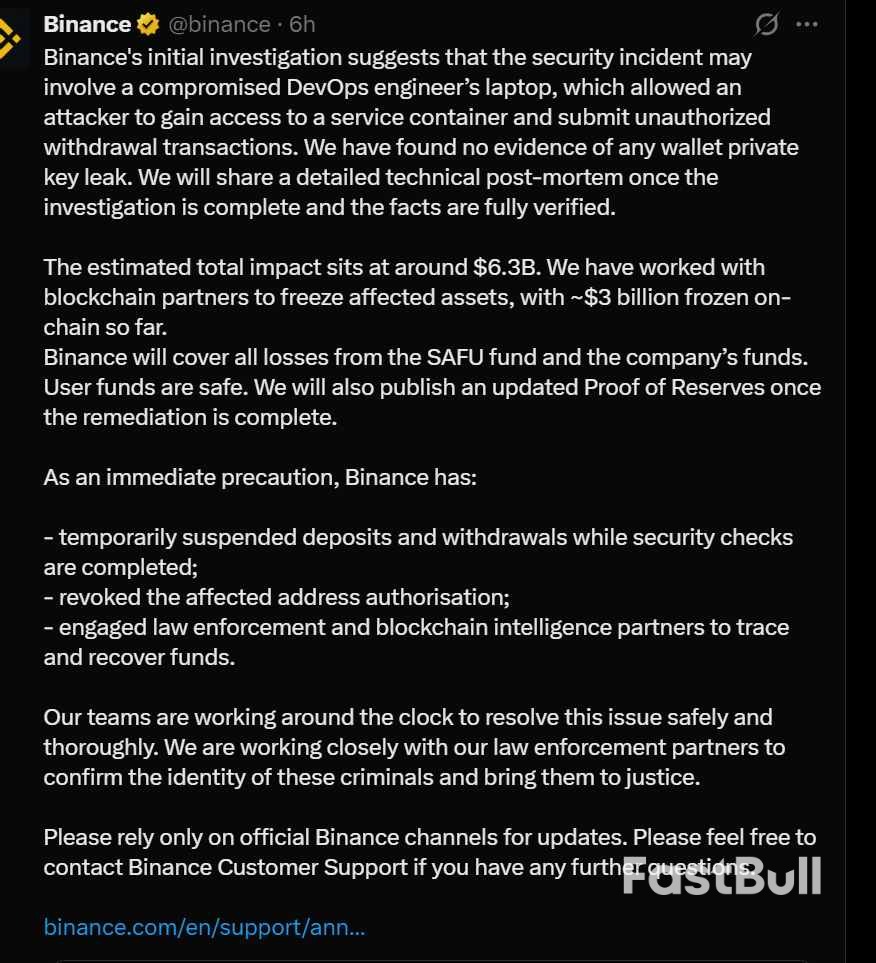
Binance’s initial statement.
| Issue | Disclosure and limits |
|---|---|
| Incident date | October 29, 2026 |
| Initial update | October 30, 2026 |
| Estimated impact | Approximately $6.3 billion, according to Binance |
| Assets frozen | Around $3 billion, according to Binance; not necessarily returned assets |
| Possible entry point | A compromised DevOps engineer’s laptop |
| Private keys | Binance says it has found no evidence of a wallet private-key leak |
| Loss coverage | Binance has committed to using SAFU and company funds |
| Operational restrictions | Deposits and withdrawals temporarily suspended for security checks |
| Outstanding disclosures | Full technical post-mortem, final loss accounting, and updated proof of reserves |
Binance’s statement does not establish how the laptop was compromised, whether any particular employee was responsible, or precisely how each unauthorized transaction was approved. A potential initial access route should not be mistaken for a completed explanation of a multistage attack.
How a compromised laptop could lead to unauthorized withdrawals
DevOps teams connect software development with deployment and operations. Depending on their duties, engineers may work with cloud infrastructure, service containers, deployment tools, service accounts, monitoring systems and production access credentials. These are general features of the role, not a description of the particular employee’s verified permissions at Binance.
An attacker controlling an engineer’s endpoint may try to reuse an authenticated session, obtain credentials or reach an internal service. That does not mean the laptop alone can move money. The subsequent path depends on the access controls, approval requirements and signing infrastructure between that endpoint and the exchange’s wallets.
Binance’s preliminary account identifies a possible sequence: an endpoint compromise, access to a service container, and the submission of unauthorized withdrawal transactions. The investigation still needs to explain which controls were crossed at each stage. Phishing, malicious software and stolen credentials are possible entry methods in general; Binance has not confirmed which, if any, was used here.
Why “no private-key leak” does not mean “no signing risk”
A private key enables a valid blockchain signature. Protecting the key from being copied is essential, but an exchange must also control which requests its signing systems will accept. If an attacker can cause an authorized service to submit or approve an illegitimate transaction, a valid signature may be produced without the key being extracted.
That is the difference between stealing a key and abusing a process that is allowed to use it. Authentication determines who can enter a system; authorization determines what they may do; withdrawal controls assess the transaction; and signing controls govern whether the request is executed. Monitoring must detect and interrupt activity that escapes those checks.
This mechanism explains how the two claims could coexist. It does not prove that a particular signing system or control failed in Binance’s case. That requires the promised technical report.
TRM Labs’ attribution and the reported timeline
Blockchain intelligence firm TRM Labs attributes the attack with high confidence to the North Korea-linked TraderTraitor group, based on its on-chain and off-chain investigation. It reports approximately $6.36 billion in transfers across ten blockchain networks, with most transfers occurring in about 20 minutes. This is TRM Labs’ assessment, distinct from a final attribution by Binance.
The reported sequence begins on October 28 with preparations including funding operational wallets, deploying code and testing. Large unauthorized transfers followed on October 29. Tracking and asset-freezing efforts continued into October 30, when Binance issued its initial explanation and loss-coverage commitment.
TRM Labs’ technical analysis also discusses Ethereum’s EIP-7702 authorization mechanism, signatures prepared in advance and hot-wallet transaction execution. These details may help reconstruct how assets moved, but a third-party account of the mechanism should not be treated as Binance’s completed root-cause analysis.
Moving funds across several networks can complicate containment. Each network has different transaction rules, token controls and service providers. Funds may be dispersed among addresses or exchanged for different assets, requiring investigators to coordinate across issuers, platforms and jurisdictions. The existence of multiple affected networks does not, by itself, prove that every wallet was compromised in the same way.
Frozen funds are not the same as recovered funds
Binance’s estimate of approximately $3 billion frozen differs from TRM Labs’ figure of around $2.7 billion at the time of its analysis. Different observation times, asset coverage or valuation methods could explain the gap. Neither figure should be treated as a final cash recovery without a reconciliation.
On public blockchains, investigators can trace addresses, transaction hashes and subsequent transfers. Some centrally issued tokens, including certain stablecoins, allow the issuer to restrict specific addresses under its legal and operational procedures. That can prevent affected tokens from moving while an investigation continues.
Freezing is a containment measure. Recovery requires assets to be returned to the party entitled to receive them. Establishing ownership, coordinating with issuers and law enforcement, resolving legal claims and executing the return may all take additional time. An immobilized balance therefore cannot automatically be counted as money already available to fund customer withdrawals.
Bitcoin has no central issuer able to freeze arbitrary addresses at the protocol level. Service providers can still monitor the movement of affected bitcoin and restrict transactions involving identified addresses, but those measures differ from an issuer-level token freeze.
The simplest accounting mistake would be to subtract $3 billion from $6.3 billion and announce a confirmed $3.3 billion loss. That subtraction produces a provisional difference between two estimates. It does not account for whether frozen assets are recoverable, valuation changes, the scope of each figure or additional recoveries. Final net losses require an asset-by-asset reconciliation.
Can SAFU cover the losses?
SAFU stands for Secure Asset Fund for Users. Binance established it as an emergency protection fund, originally building it by allocating a portion of trading fees. Its February 2026 FAQ described approximately $1 billion in crypto assets at that time. That historical amount is not necessarily the fund’s current realizable value.
The FAQ identifies Nest Clearing and Custody Limited as the custodian and manager, with the relevant custody arrangements regulated by the Financial Services Regulatory Authority of Abu Dhabi Global Market. A regulated custody arrangement does not itself establish that every loss is covered or that the fund is large enough for a particular incident.
SAFU is one funding source, not the whole commitment
The approximately $1 billion figure and the $6.3 billion estimated incident impact are materially different in size. Binance has nevertheless committed to covering losses through both SAFU and company funds. Its statement is therefore broader than a promise that SAFU alone will pay the entire amount.
Assessing that commitment requires separate evidence about four items: available SAFU assets, accessible company funds, assets actually recovered, and the ultimately established net loss. A historical fund balance does not prove Binance lacks the other resources, but a public promise does not quantify them either.
SAFU is not unconditional insurance
The general SAFU rules concern qualifying losses, including eligible losses arising from vulnerabilities or defects in Binance’s systems or security protocols. Eligibility is determined under the fund’s rules. Binance’s FAQ describes a customer-support claim process and generally requires claims to be submitted within 90 days of an eligible loss.
Those general terms should be distinguished from Binance’s incident-specific commitment to cover all losses using SAFU and company funds. Customers should follow the instructions issued for this incident rather than assume that the general application process establishes an immediate claim, a payout amount or an automatic deadline for every account holder.
If an account shows an unauthorized transaction or an unexplained asset discrepancy, useful records include transaction histories, transaction hashes, screenshots and customer-support correspondence. A customer whose account has no identified loss should not assume that the incident itself creates an individual compensation claim.
What customers can check now
An exchange-level security incident and a compromise of an individual customer account are different problems. The latter may involve a stolen password, a phishing site, an exposed API key or a compromised personal device. Binance’s statement about covering this incident should not be read as a blanket guarantee covering every unrelated account-security loss.
A practical review starts with account records:
- Check asset balances and recent transfers against your own records.
- Review recent login activity and recognized devices.
- Examine API permissions and activity for changes you did not authorize.
- Check whether withdrawal-address allowlists have changed.
- Read security notices inside the official account interface.
- Verify the current deposit and withdrawal status of the specific asset and network involved.
An unchanged displayed balance is useful information about the account ledger, but it is not independent proof of the exchange’s solvency or the availability of every withdrawal route. Conversely, a temporary operational restriction does not establish that the customer’s assets have disappeared.
Does a withdrawal suspension prove a liquidity crisis?
No. Wallet checks, permission changes and transaction investigations can require a suspension even when a platform says it can meet customer claims. Binance describes this suspension as a precaution while it completes security checks.
The relevant evidence is the scope and duration of the restrictions, whether updates are specific and consistent, whether containment is effective, and whether withdrawals resume as announced. Those observations are more informative than treating either the suspension or a reassurance as conclusive on its own.
As of the October 30 initial statement, Binance had not supplied a single reopening time covering all services. Different networks may resume at different times. Verify the actual network status before attempting a transfer rather than relying on an estimated reopening time circulating on social media.
Moving assets creates a different set of risks
During an incident, rushed transfers can introduce address errors, network mismatches, unexpected fees and exposure to phishing messages. A purported support representative asking for a seed phrase is not a recovery route.
Longer-term custody choices depend on what the assets are used for. Trading liquidity, long-term holdings and contingency funds need not all be held in the same place. Self-custody can reduce reliance on an exchange, but it transfers responsibility for private keys, backups and transaction execution to the holder. It does not eliminate the possibility of loss.
What would demonstrate that the incident is resolved?
A reopening announcement is an operational milestone. A complete explanation needs to go further. Binance’s promised post-mortem should address the original access route, the permissions available to the compromised endpoint, access to the service container, and how unauthorized withdrawal requests reached execution.
It should also explain why several networks were affected, which controls detected or failed to stop the activity, and how remediation prevents the same path from being reused. Where the investigation is still incomplete, the report should identify those limits rather than imply that every unanswered question has been settled.
Financial closure requires its own evidence: the final amount affected, assets frozen versus returned, remaining losses, the resources used to meet those losses and confirmation that customer obligations were fulfilled. These are separate from identifying the attacker.
Three developments are particularly consequential for confidence: verifiable recovery and loss coverage, an intelligible technical account of the failure and its remediation, and updated asset disclosures that can be reconciled with the platform’s obligations.
Evaluating exchange custody beyond brand size
Large trading volumes, a familiar brand and competitive fees do not establish the strength of a platform’s custody controls. An exchange can offer a liquid market while still leaving important questions about access privileges, asset segregation or emergency funding unanswered.
| Area | Evidence to examine |
|---|---|
| Legal and regulatory position | The actual operating entity, jurisdiction and applicable authorizations |
| Asset disclosures | The scope, timing and methodology of reserve and liability reporting |
| Custody | Customer-asset segregation, hot- and cold-wallet arrangements and custody responsibilities |
| Technical controls | Endpoint protection, privileged access, signing controls and separation of duties |
| Withdrawals | Approval rules, anomaly detection and clear restriction notices |
| Incident funding | The terms and available resources of funds, insurance or company commitments |
| Transparency | Specific updates, technical findings and verifiable remediation |
A proof-of-reserves exercise is not equivalent to a comprehensive financial audit. Depending on its design, it may show selected assets and customer liabilities at a particular time without addressing every corporate obligation, encumbrance, operational control or subsequent movement. Its usefulness depends on what is included and what can be independently checked.
For Binance, the loss-coverage commitment is important, but the test is execution. Funds must be recovered or replaced, customer obligations met, and the withdrawal and authorization systems secured. Those outcomes, rather than the headline size of SAFU alone, will determine how effectively the exchange handles the incident.
Frequently asked questions
Was $6.3 billion permanently lost?
Binance describes approximately $6.3 billion as the estimated total impact. It also reports roughly $3 billion frozen. Frozen assets are not necessarily returned, and the final net loss has not been established by those two estimates.
Were Binance’s wallet private keys leaked?
Binance says its initial investigation has found no evidence of a wallet private-key leak. That is a statement about the evidence found so far, not a completed conclusion about every part of the incident.
Was a DevOps engineer responsible?
Binance identifies a potentially compromised laptop as a possible starting point. That does not establish personal responsibility for the attack or mean that one employee’s permissions alone explain the entire transaction path.
Does SAFU guarantee every customer loss?
The general fund has eligibility rules and a claim process. Binance has separately committed to covering losses from this incident using SAFU and company funds. Neither statement should be extended to unrelated losses without checking the applicable terms.
Has Binance confirmed the attackers’ identity?
TRM Labs attributes the attack with high confidence to the North Korea-linked TraderTraitor group. That is the intelligence firm’s attribution; it should be distinguished from Binance’s own final investigative findings.
When will deposits and withdrawals resume?
The initial October 30 statement does not provide a uniform reopening time for every service. Customers need to check the announcement and status for the particular asset, network and function they intend to use.


