

Why GM's Stock is Hitting Record Highs
 Nathaniel Wright
General Motors defies industry challenges, achieving record highs and outperforming rivals with shrewd strategic execution.
General Motors is mastering a high-wire act, skillfully balancing profitability, its vehicle lineup, and the unpredictable political landscape of the Trump administration. The Detroit automaker’s strong 2025 performance has catapulted its stock to a new record, fueled by an earnings beat and an optimistic forecast for 2026 that includes a 20% dividend increase and a new $6 billion stock buyback program.
While consistent performance isn't new for GM, Wall Street analysts highlight that the company is attracting more investor attention than its competitors, especially as the U.S. auto industry faces slowing sales, political uncertainty, and tariffs.

Mary Barra, CEO of General Motors, pictured at the Allen and Co. Sun Valley conference on July 8, 2025.
Wall Street's Verdict: GM Outperforms Rivals
Shares of GM have surged more than 70% over the past year, prompting multiple analysts to raise their price targets to record levels. TD Cowen, for example, increased its target by 10% to $122 per share following the earnings report.
"GM stands out for strong execution, proven resilience, high earnings quality (i.e. strong [free cash flow] amid inventory de-stock), capital allocation and a unique NA Truck Franchise," wrote TD Cowen analyst Itay Michaeli in a note to investors.
The company is increasingly distinguishing itself from its closest U.S. competitors, Ford Motor and Stellantis, in both earnings and capital management.
"We rate GM Overweight for its best-in-class execution amongst North America–based auto OEMs, consistent management team and strategy, and strong product portfolio allowing for above-industry pricing and margin," noted JPMorgan analyst Ryan Brinkman.
This contrasts sharply with its rivals:
• Ford: While its stock is up over 35% in the past year, Ford's adjusted earnings forecast is about half of what GM reported for 2025, and its free cash flow expectations have trailed GM's by billions.
• Stellantis: The company is undergoing a major restructuring, and its U.S.-listed shares have fallen roughly 27% over the past year amid results that have largely disappointed Wall Street.
For 2025, GM reported net income of $2.7 billion, adjusted EBIT of $12.7 billion, and adjusted automotive free cash flow of $10.6 billion.
Navigating Tariffs and Political Headwinds
A key part of GM's success has been its ability to navigate the political uncertainty under President Donald Trump. The primary challenge for the auto industry has been rising costs from tariffs and inflation, which GM expects will cost it $3.5 billion and $1.25 billion respectively in 2026.
However, the company has a clear plan to mitigate these pressures. GM anticipates offsetting these costs with:
• $500 million to $750 million in regulatory savings from Trump administration policies.
• Narrower EV losses of $1 billion to $1.5 billion due to lower production.
• Billions in other benefits related to pricing and warranty expenses.
"For '26, commodity and onshoring headwinds could be offset by regulatory benefits, warranty improvements, narrowing EV losses, and lower tariffs resulting from USMCA negotiations," said RBC Capital analyst Tom Narayan.
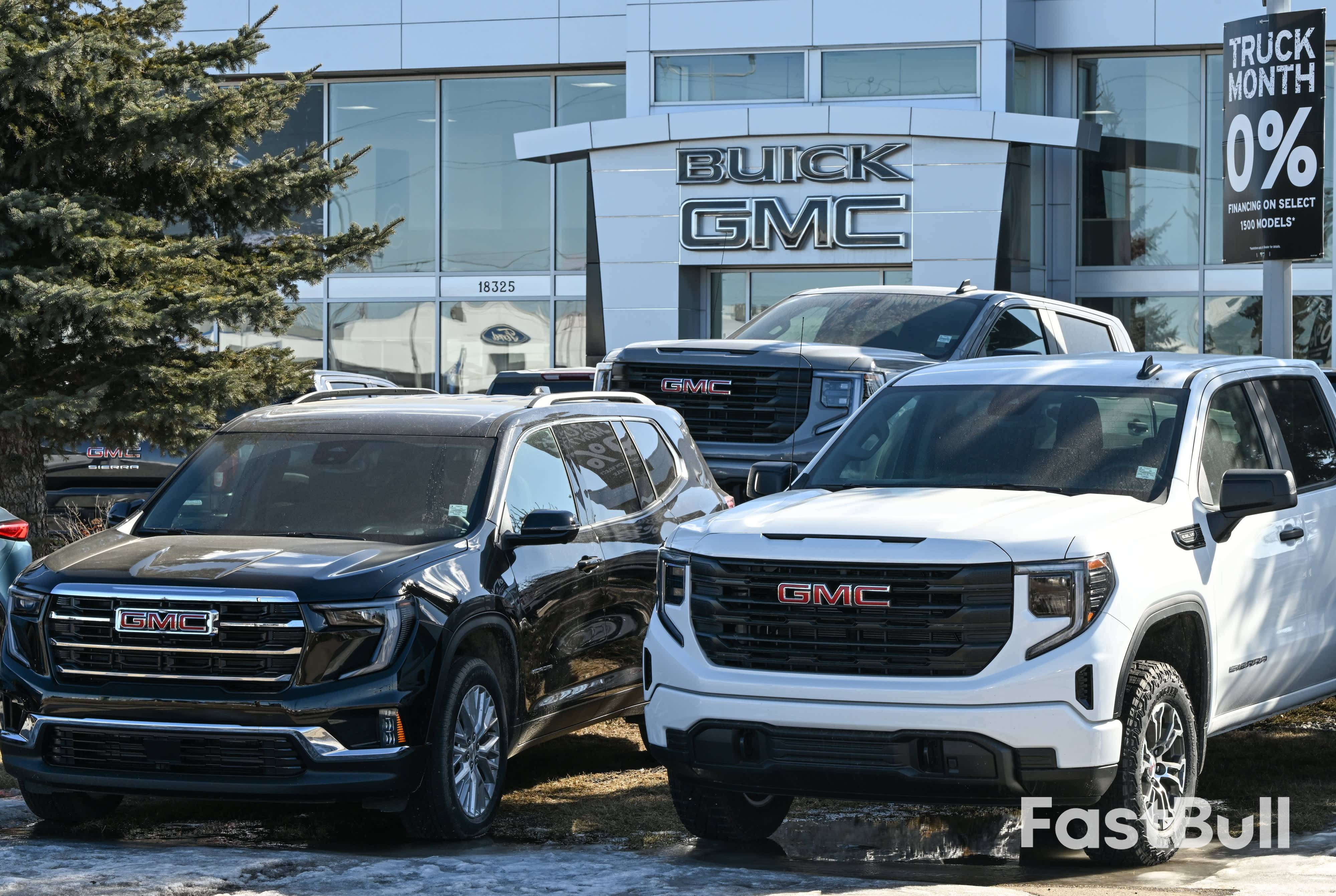
GM's strategy includes a focus on profitable internal combustion vehicles, such as these GMC SUVs at a dealership in Canada.
GM's strategic retreat from an aggressive EV push, marked by $7.9 billion in write-downs last year, allows it to focus on selling more profitable traditional vehicles with internal combustion engines. With federal penalties for fuel economy standards eliminated by the Trump administration, GM can produce these popular vehicles without incurring billions in costs for regulatory credits.
GM CFO Paul Jacobson emphasized that the company's success ultimately hinges on its ability to adapt. "In the face of a rapidly evolving industry and significant macro challenges, the resilience and adaptability of the GM team have been truly exceptional," he said.
A Fortress Balance Sheet Fueled by Cash Flow
GM's strategic flexibility is backed by a formidable cash position. Jacobson noted the company ended 2025 with over $20 billion, supported by its $12.7 billion in adjusted earnings and $10.6 billion in adjusted automotive free cash flow.
Over the last five years, GM has increased its average annual free cash flow from $3 billion to $10 billion. "This robust cash generation enables us to execute confidently across all pillars of our capital allocation framework," Jacobson stated.
Looking ahead, the company plans to invest $10 billion to $12 billion annually in 2026 and 2027. This includes approximately $5 billion to expand U.S. manufacturing for high-demand vehicles and reduce its exposure to tariffs.
This strong cash flow has also enabled GM to return $23 billion to shareholders through stock repurchases since November 2023. These buybacks have eliminated nearly 35% of its outstanding shares, boosting the stock price.
A Resilient Model for the Future
Analysts believe GM has fundamentally transformed its business, making it far more resilient than in the past.
"We think it's important to remember this is a very different business today vs. the GM of a decade ago, with a much more resilient earnings profile than appreciated, and a more balanced and pragmatic approach to investment," said Barclays analyst Dan Levy.
The company's performance sets a high bar for competitors. GM's 2026 guidance projects net income between $10.3 billion and $11.7 billion, adjusted EBIT of $13 billion to $15 billion, and earnings per share between $11 and $13. The automaker also signaled that its costs and earnings should continue to improve beyond 2026 as it realigns its product lineup and brings more production onshore to the U.S.


