

Stock Trading Simulator: How It Works and How to Practice Trading
 zhan chen
Learn how a stock trading simulator works, explore its benefits and limitations, and discover how to practice trading strategies without risking real money.
A stock trading simulator allows investors to buy and sell stocks using virtual money instead of real capital. It recreates many aspects of the stock market, including price movements, order placement, and portfolio performance, giving beginners a practical way to learn how trading works.
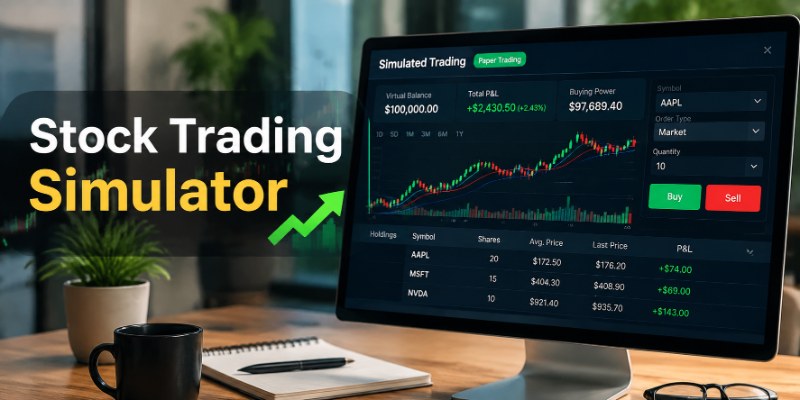
Table of Contents
- 1. What Is a Stock Trading Simulator?
- 2. How Does a Stock Trading Simulator Work?
- 3. Benefits of Using a Stock Trading Simulator
- 4. Best Features to Look for in a Stock Trading Simulator
- 5. Stock Trading Simulator vs. Real Trading
- 6. Types of Stock Trading Simulators
- 7. How to Use a Stock Trading Simulator Effectively
- 8. Common Mistakes to Avoid When Using a Stock Trading Simulator
- 9. Stock Trading Simulator vs. Backtesting
- 10. When Should You Move From Simulated Trading to Real Trading?
- 11. Frequently Asked Questions
- 12. Final Thoughts
Whether you are new to investing or testing a new strategy, a simulator can help you build experience before committing real money. However, understanding its limitations is just as important as learning how to use one.
What Is a Stock Trading Simulator?
A stock trading simulator is a platform that replicates real-world stock trading with virtual funds. Users can create a simulated portfolio, place buy and sell orders, and track performance without putting actual money at risk.
Most simulators use real-time or delayed market data to reflect changes in stock prices. Some also reproduce trading features such as limit orders, stop orders, market orders, and portfolio allocation.
For example, imagine starting with $100,000 in virtual cash. You decide to buy 20 shares of a company trading at $150 per share. The simulator deducts $3,000 from your virtual balance and adds the shares to your portfolio.
If the stock price rises to $165, your simulated position gains $300. If it falls to $135, the position loses $300.
The results are virtual, but the process helps you understand how price movements affect a portfolio.
How Does a Stock Trading Simulator Work?
Most stock trading simulators follow a straightforward process. Although the interface varies between platforms, the basic experience is similar to using an online brokerage account.
1. Create a Virtual Trading Account
First, register with a platform that offers simulated trading. Some services provide a dedicated paper trading account, while others include simulation features within their regular brokerage platforms.
You may receive a predefined virtual balance, such as $10,000, $50,000, or $100,000.
2. Choose Stocks to Trade
Once your account is ready, search for stocks using their company names or ticker symbols.
You can select individual companies, exchange-traded funds (ETFs), or other supported financial instruments, depending on the simulator.
3. Place Simulated Orders
Choose how many shares you want to buy or sell and select an order type.
Common order types include:
- Market order: Attempts to execute immediately at the available market price.
- Limit order: Executes only at your specified price or better.
- Stop order: Becomes a market order after the specified stop price is reached.
- Stop-limit order: Becomes a limit order after the stop price is triggered.
4. Monitor Your Portfolio
After placing an order, the simulator updates your virtual holdings and cash balance.
You can monitor unrealized gains and losses, completed trades, portfolio allocation, and overall performance.
5. Review Your Trading Results
The final step is evaluating your decisions. Look at which trades performed well, where you made mistakes, and whether your strategy followed its original rules.
Keeping a trading journal can make this process more useful by recording entry prices, exit prices, reasons for entering trades, and lessons learned.
Benefits of Using a Stock Trading Simulator
A stock trading simulator offers several advantages, particularly for beginners who want to understand the market before investing their savings.
Practice Without Financial Risk
The most obvious benefit is that you do not lose real money when a simulated trade goes wrong.
You can experiment with different stocks, order types, and strategies without worrying about losing your initial capital.
This makes simulators useful for learning basic trading mechanics and understanding how market movements affect investments.
Learn How to Use Trading Platforms
Brokerage platforms can be confusing for new investors. Charts, order tickets, watchlists, indicators, and portfolio tools may take time to understand.
A simulator provides an opportunity to become familiar with these features before placing actual orders.
Test Different Trading Strategies
You can use simulated accounts to experiment with various approaches, including:
- Day trading and short-term momentum strategies.
- Swing trading based on price patterns.
- Trend-following strategies.
- Breakout and support-and-resistance trading.
- Long-term stock investing.
Comparing results across different strategies helps you understand which approaches deserve further research.
Improve Risk Management
Successful trading involves more than choosing stocks that might rise. Position sizing, stop-loss placement, and portfolio diversification also matter.
A simulator allows you to practice these techniques and see how different risk levels affect your overall results.
Build Trading Confidence
Repeated practice can help beginners become more comfortable with market terminology, price fluctuations, and order execution.
However, confidence should come from consistent decision-making rather than a few profitable simulated trades.
Best Features to Look for in a Stock Trading Simulator
Not every simulator provides the same experience. Some focus on basic investing education, while others offer advanced charting and realistic order execution.
The following features are worth considering:
| Feature | Why It Matters |
|---|---|
| Virtual starting balance | Provides capital for simulated trades |
| Real-time market data | Helps reflect current market movements |
| Advanced charts | Supports technical analysis |
| Multiple order types | Allows realistic order practice |
| Portfolio tracking | Measures gains, losses, and allocation |
| Trading history | Helps review previous decisions |
| Performance reports | Identifies strengths and weaknesses |
| Mobile access | Allows practice across devices |
For beginners, an easy-to-use interface and reliable price data are usually more important than a large collection of advanced indicators.
More experienced traders may prefer platforms with customizable charts, technical indicators, and detailed performance statistics.
Stock Trading Simulator vs. Real Trading
Although simulators recreate many brokerage functions, simulated trading is not identical to trading with real money.
| Category | Stock Trading Simulator | Real Trading |
|---|---|---|
| Capital | Virtual money | Actual money |
| Financial risk | No direct trading loss | Possible loss of capital |
| Emotional pressure | Usually lower | Often higher |
| Order execution | Simulated | Subject to market conditions |
| Slippage | May be simplified | Can affect actual execution |
| Trading fees | May be excluded | May apply |
| Dividends | Depends on platform | Actual eligible payments |
| Market impact | Usually not modeled | Can affect execution |
One important difference is emotional pressure.
When using virtual funds, it is easier to hold a losing position or take an aggressive trade because there is no real financial consequence. With actual money, fear and greed can influence decisions.
Execution quality is another limitation. Simulators may not fully reproduce bid-ask spreads, liquidity constraints, partial fills, or rapid price changes.
As a result, strong simulated performance does not guarantee similar results in a live account.
Types of Stock Trading Simulators
Different simulators are designed for different trading styles and experience levels.
Browser-Based Stock Simulators
These platforms run directly in a web browser and generally do not require installing desktop software.
They are convenient for beginners who want to practice buying and selling stocks, monitor virtual portfolios, and learn basic market concepts.
Broker-Integrated Paper Trading Platforms
Some online brokers provide simulated accounts alongside their regular brokerage services.
For example, Interactive Brokers offers a paper trading environment that allows users to explore trading tools and strategies without executing actual exchange transactions. Its simulator also has certain differences from live trading. Learn about paper trading.
These platforms can be particularly useful for traders who eventually plan to use the same broker for real investments.
Mobile Stock Trading Simulators
Mobile simulators allow users to practice trading through smartphones or tablets.
They are suitable for people who want to monitor virtual positions, check stock prices, and learn how trading applications work while away from their computers.
Educational Stock Market Games
Some simulators are designed primarily for financial education rather than professional trading.
For example, The Stock Market Game provides a virtual investment portfolio that helps participants learn about stocks, bonds, diversification, and investment decisions.
Its official website provides information about its educational programs and simulated investing activities.
How to Use a Stock Trading Simulator Effectively
Simply placing virtual trades is not enough to develop good trading habits. A structured approach makes practice more valuable.
Here are five steps to get better results.
Step 1: Set a Realistic Starting Balance
Choose a virtual balance that reflects the amount you could reasonably afford to invest.
For example, if you expect to start investing with $5,000, avoid practicing with $500,000 in virtual funds.
A realistic balance encourages more practical decisions about position sizing, diversification, and risk exposure.
Step 2: Establish a Trading Strategy
Decide what type of trading you want to practice before placing your first order.
For example:
- Day trading focuses on opening and closing positions within the same trading day.
- Swing trading involves holding positions for several days or weeks.
- Position trading focuses on longer-term price trends.
- Buy-and-hold investing involves purchasing assets with the intention of holding them over an extended period.
Each approach requires different research methods and risk management techniques.
Step 3: Follow Consistent Risk Management Rules
Practice using the same risk controls you would apply to a real account.
For example, you might decide not to risk more than 1% of your simulated portfolio on a single trade.
If your virtual portfolio contains $10,000, that would mean limiting the planned loss on an individual trade to $100.
The exact percentage depends on your strategy and risk tolerance. The important point is to establish rules and follow them consistently.
Step 4: Record Every Trade
Maintain a trading journal that includes:
- Stock ticker and company name.
- Entry and exit prices.
- Position size.
- Reason for entering the trade.
- Stop-loss and profit target.
- Final result.
- Lessons learned.
This information helps you identify recurring mistakes and evaluate whether your strategy is actually working.
Step 5: Evaluate Performance Over Time
Do not judge a strategy based on two or three successful trades.
Instead, review a meaningful sample of trades across different market conditions.
Pay attention to metrics such as:
- Win rate.
- Average profit per winning trade.
- Average loss per losing trade.
- Risk-to-reward ratio.
- Maximum drawdown.
- Total return.
A strategy with a high win rate is not necessarily profitable if its occasional losses are significantly larger than its gains.
Common Mistakes to Avoid When Using a Stock Trading Simulator
Simulated trading can create bad habits if users focus only on virtual profits.
Here are several mistakes worth avoiding.
1. Taking excessive risks: Virtual money can encourage traders to make oversized bets or use aggressive strategies. These habits can become dangerous when real capital is involved.
2. Ignoring trading costs: Some simulators do not accurately account for commissions, spreads, financing costs, or other expenses. Include realistic estimated costs when evaluating performance.
3. Overtrading: Making frequent trades simply because there is no financial risk can encourage impulsive decisions. Every trade should have a clear reason.
4. Changing strategies too frequently: Switching approaches after every losing trade makes it difficult to determine whether a strategy has a genuine advantage.
5. Confusing simulated profits with real trading ability: A profitable virtual portfolio does not prove that a trader can consistently make money in live markets.
6. Ignoring market conditions: A strategy that performs well during a strong bull market may struggle during periods of volatility or prolonged declines.
Stock Trading Simulator vs. Backtesting
A stock trading simulator and a backtesting tool are related but serve different purposes.
A stock trading simulator allows you to practice placing trades in a simulated market environment, often using current or delayed market data.
Backtesting evaluates a trading strategy against historical market data to estimate how it would have performed in the past.
| Category | Stock Trading Simulator | Backtesting |
|---|---|---|
| Data | Live, delayed, or simulated | Historical |
| Main purpose | Practice trading | Evaluate strategies |
| Order placement | Simulated orders | Historical trade calculations |
| Decision-making | Often manual | Usually rule-based |
| Market conditions | Current or simulated | Past market conditions |
| Main benefit | Develop practical skills | Identify historical strategy performance |
For example, if you have a moving-average crossover strategy, backtesting can show how it performed over the previous five years.
A simulator can then help you practice applying the same rules to current market conditions.
Using both tools provides a more complete approach to trading preparation.
When Should You Move From Simulated Trading to Real Trading?
There is no universal period that determines when someone is ready to trade with real money.
Some beginners practice for several weeks, while others need several months to understand market behavior and develop consistent habits.
Rather than focusing entirely on time, consider whether you can meet the following conditions:
- You understand basic market terminology and order types.
- You have a clearly defined trading strategy.
- You follow consistent position-sizing and risk management rules.
- You have reviewed a meaningful number of simulated trades.
- You understand the reasons behind both profitable and losing trades.
- You can accept that real trading involves financial losses and emotional pressure.
Even after meeting these conditions, consider starting with a small amount of money rather than immediately committing a large portion of your savings.
A gradual transition makes it easier to understand the differences between simulated and live execution.
Frequently Asked Questions
Is a stock trading simulator free?
Many stock trading simulators offer free access to basic virtual trading features. Some broker-integrated platforms require an account, while advanced tools or market data subscriptions may involve additional costs.
Can you make real money with a stock trading simulator?
No. A standard stock trading simulator uses virtual funds, so simulated profits cannot normally be withdrawn as cash. Its purpose is to provide a practice environment.
Is paper trading the same as using a stock trading simulator?
Yes. Paper trading is another term for simulated trading. Both allow users to practice buying and selling financial instruments without committing actual capital.
Do stock trading simulators use real-time prices?
Some use real-time market data, while others rely on delayed prices or simulated market information. Check the platform's data policy before using it to evaluate a trading strategy.
Can beginners use stock trading simulators?
Yes. Beginners can use simulators to learn how stock orders work, understand portfolio management, and practice basic investment strategies before opening a funded brokerage account.
Are stock trading simulators accurate?
They can provide a useful approximation of market activity, but they do not always reproduce real execution conditions. Differences in liquidity, slippage, order fills, and emotional pressure can affect actual trading results.
Final Thoughts
A stock trading simulator is a practical starting point for anyone who wants to understand the stock market and develop trading skills without risking real money.
It provides a place to learn order execution, test strategies, practice risk management, and evaluate investment decisions.
However, virtual profits should not be treated as proof of future success. The most valuable use of a simulator is not achieving the highest possible return, but developing a consistent process that can be evaluated and improved before real money is involved.


