

Market navigator: week of 1 December 2025
 Adam
AdamSummary:
U.S. data weakness boosted expectations for a December Fed cut as stocks rebounded and precious metals rallied. China’s contraction deepened, Australia’s inflation rose, and markets now await key PCE, PMI, and eurozone inflation readings.
What happened last week
US economy slowdown: Data delayed by government shutdown revealed an uptick in wholesale inflation of 0.3% month-on-month (MoM) in September, in line with expectations, whilst retail sales growth slowed from 0.6% to 0.2% MoM. Consumer confidence in November dropped to the lowest level since April and private employment in ADP's weekly survey saw a decline of 13,500 jobs. These economic data provide more justification for the Federal Reserve (Fed) to cut rates at its December meeting.
Contraction in China: China's official purchasing managers' index (PMI) data shows manufacturing PMI at 49.2 – in contraction for the eighth consecutive month – whilst services and construction activities dropped below the growth threshold to 49.5, the first contraction in almost three years. The PMIs reveal weak demand in both domestic and overseas markets. Selling prices continued to fall amid intensive price competition. With limited policy support, China's 5% growth ambition may be at risk.
Accelerating prices in Australia: The Bureau of Statistics transitioned its full CPI report from quarterly to monthly starting October. Headline inflation rose 3.8% year-on-year (YoY) from September's 3.6%, driven by housing (+5.9%), food (+3.2%) and recreation (+3.2%). The Reserve Bank of Australia's (RBA) preferred measure – trimmed mean CPI – spiked from 3% to 3.3%. Not only is a rate cut by February almost completely ruled out, but a small group of market participants are starting to bet on a hike next year.
Markets in focus
US stocks rebound on rate cut hopes
US equity markets rebounded sharply last week as latest economic data provided justification for a rate cut at the Federal Open Market Committee (FOMC) meeting on 10 December. The probability of a 25-basis point cut increased further from last week's 70% to close to 90%. The S&P 500 climbed 3.7%, closing just in positive territory for the month of November. The Nasdaq 100 rallied 4.9% – its best weekly performance since mid-May. The Volatility Index plunged, dropping to 16 from the previous peak of 28. That said, trading volume was 10–20% lower than the 30-day average due to the Thanksgiving holiday.
Last week's gains were led by technology stocks. The successful launch of Google's Gemini 3 AI model drove Alphabet's share price up by 6.8%, whilst its tensor processing unit (TPU) partner Broadcom surged 18.5%. Meanwhile, Nvidia's share price dropped 1.1% as reports of Google potentially selling its TPU externally may challenge Nvidia's dominance in the AI chip market. Agricultural equipment company Deere was the worst performing stock in the S&P 500 last week after reporting a decline in fourth-quarter earnings and a downward revision in 2026 forward guidance.
Last week's strong recovery has brought the US Tech 100 index back above the 50-day moving average (MA), indicating that the November correction is most likely complete. However, the uptrend is starting to lose momentum, demonstrated by the lower highs in the relative strength index (RSI). The index may trade sideways this week, bounded by resistance at around 25,700 and immediate support at 24,600. A break above 25,700 will open up a path towards the historic high.
Figure 1: US Tech 100 index (daily) price chart
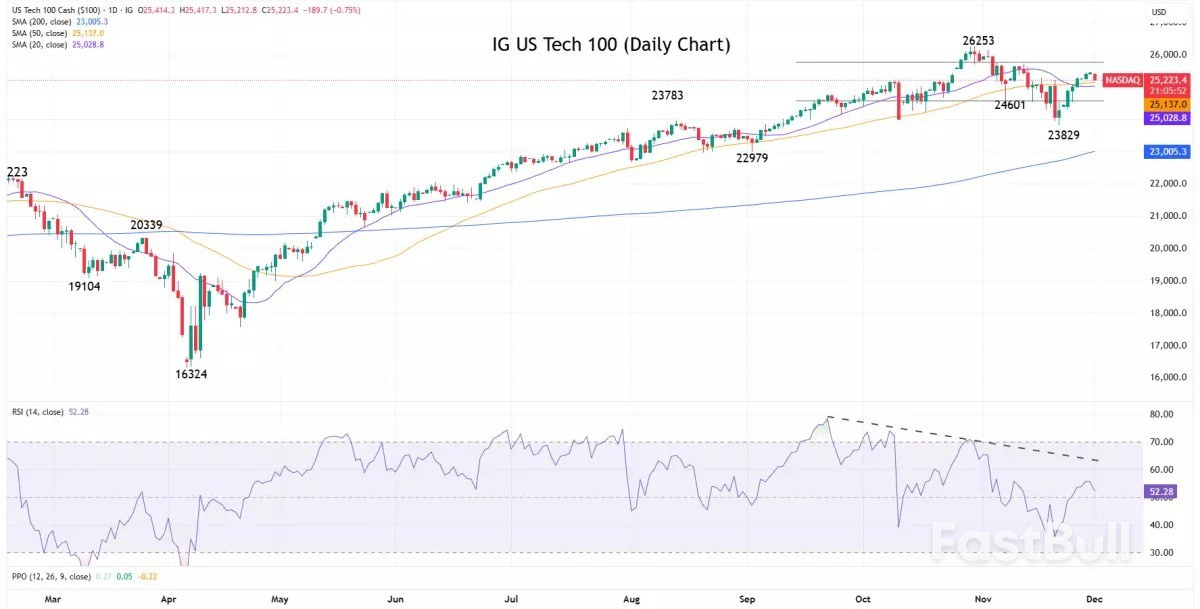 as of 1 December 2025. Past performance is not a reliable indicator of future performance.
Precious metals rally resumes
After a steep drawdown of 11% in October, gold prices bounced back to a two-week high above $4,200 per ounce, but remain 4% below the historical record set on 20 October. The latest upward move has been driven by a sharp reversal in Fed rate cut expectations after data revealed deceleration in the US economy. The US 10-year Treasury yield dropped below 4% briefly last week and the US dollar index declined by 0.7% to 99.4.
Investment sentiments have improved as many Wall Street analysts continue to be positive on gold's prospects in 2026. Bank of America has set a target of $5,000 by the end of next year, whilst Deutsche Bank has a more conservative base case target of $4,450. According to a survey conducted on 900 institutional investors by Goldman Sachs, over 70% of respondents see gold rising next year. Exchange-traded fund (ETF) net flows reverted to positive since the second week of November.
Silver, which is considered a higher beta instrument than gold, surged 11% in the past week and set a fresh historic record of $56.5 amid low liquidity on Black Friday. In addition to safe-haven demand and increasing investment flows to diversify from fiat currencies, silver also receives significant demand from industrial applications.
The gold price daily chart shows an ascending triangle pattern. A successful breakout at current levels will indicate the resumption of a bullish trend towards October's high at $4,381. Failure to breach may result in a pullback towards the 50-day MA at $4,090.
Figure 2: Spot gold (daily) price chart
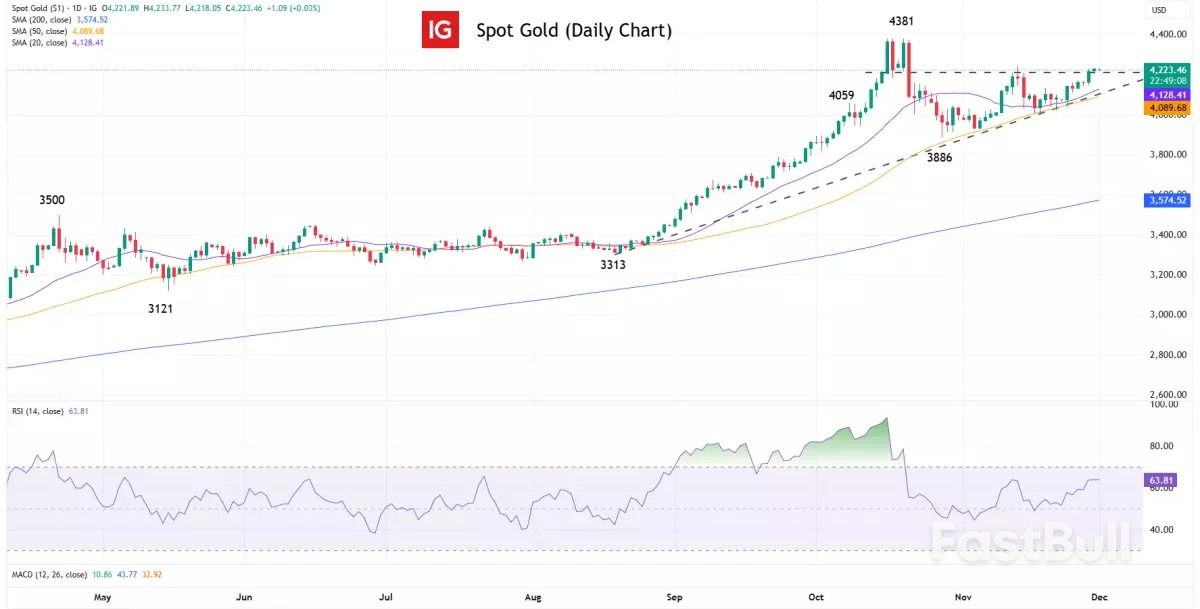 as of 1 December 2025. Past performance is not a reliable indicator of future performance.
The silver chart displays a strong bullish breakout. Silver has cleared a significant previous resistance level from the previous high at $54.4 and is accelerating upward, establishing a new high. The trend is clearly bullish. However, the market is entering overbought territory based on the RSI, which suggests a potential short-term technical correction is likely before the bullish trend resumes. It should find support from the previous high.
Figure 3: Spot silver (daily) price chart
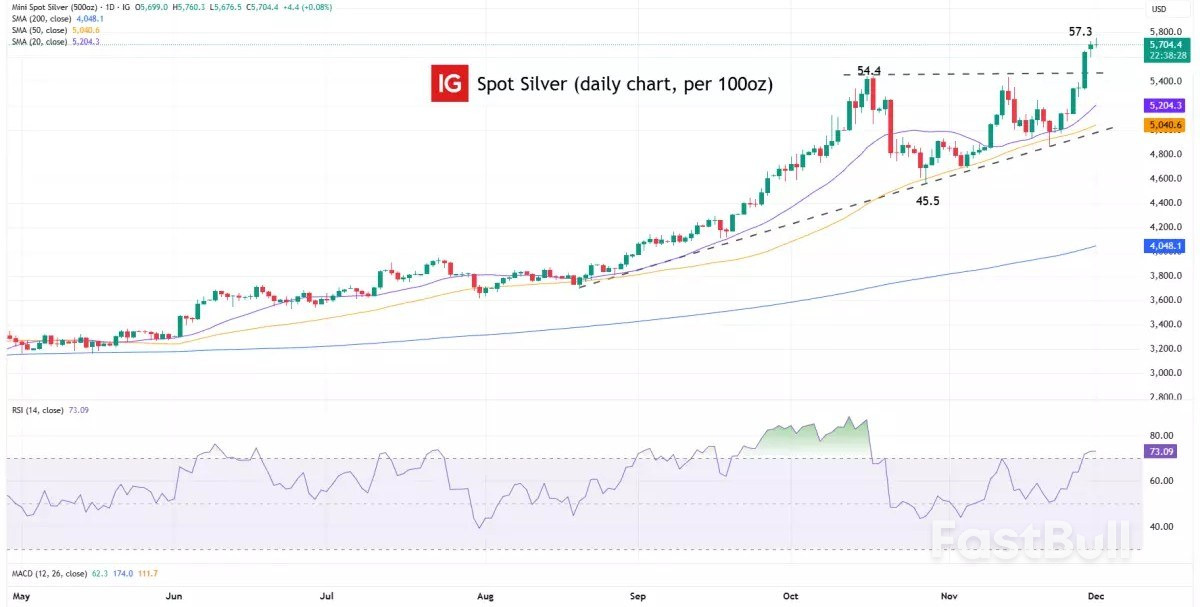 as of 1 December 2025. Past performance is not a reliable indicator of future performance.
The week ahead
The coming week centres on inflation dynamics and business activity indicators that will prove critical for monetary policy decisions ahead of year-end central bank meetings.
Friday's core Personal Consumption Expenditure (PCE) index represents the final major inflation gauge before the Fed's December policy meeting. Markets anticipate a 0.2% month-on-month reading, consistent with August's figure. Any deviation could alter expectations regarding the Fed's policy stance, particularly as the central bank weighs inflation persistence against a softening labour market. The release of personal income and spending data alongside the PCE will provide additional perspective on consumer resilience.
Manufacturing and services sector health will be assessed through PMI readings. The US ISM manufacturing PMI is expected to remain in contraction territory, whilst the services PMI should indicate healthy growth in the economy's dominant sector.
Euro area inflation data on Tuesday will prove equally significant. The anticipated acceleration to 2.2% YoY could challenge the European Central Bank's (ECB) current wait-and-see approach, as policymakers have indicated the current monetary stance seems appropriate. A material deviation from consensus could prompt reassessment of whether rates require adjustment from their present neutral level. Markets largely expect rates to remain unchanged in 2026.
On the corporate front, CrowdStrike and Salesforce report results, providing insights into enterprise technology spending and cybersecurity demand as companies finalise budgets for 2026.
Source: ig
To stay updated on all economic events of today, please check out our Economic calendar
Copyright © 2025 FastBull Ltd
News, historical chart data, and fundamental company data are provided by FastBull Ltd.
Risk Warnings and Disclaimers
You understand and acknowledge that there is a high degree of risk involved in trading. Following any strategies or investment methods may lead to potential losses. The content on the site is provided by our contributors and analysts for information purposes only. You are solely responsible for determining whether any trading assets, securities, strategy, or any other product is suitable for investing based on your own investment objectives and financial situation.


