

Indonesia stocks pare worst rout since 1998 on reform promise
 Adam
AdamSummary:
Indonesian stocks rebounded from a near-1998-level rout after regulators promised liquidity reforms to avoid an MSCI downgrade, easing panic over low free float, fiscal risks, and heavy foreign outflows.
Indonesian equities staged a late-session recovery from their deepest two-day rout in nearly three decades, as regulators rushed to implement measures aimed at averting a potential downgrade by index compiler MSCI Inc.
The benchmark Jakarta Composite Index ended the day 1.1% lower, bouncing back from an earlier 10% plunge that triggered a 30-minute trading halt. The market, which was on track for its most severe selloff since the 1998 Asian Financial Crisis, stabilized after the Financial Services Authority pledged to enforce stricter liquidity rules.
The regular said it will implement next month a rule that requires companies to have a minimum 15% free float — number of shares available to trade publicly, from the current 7.5%. Further, the nation’s new sovereign wealth fund Danantara is weighing active participation in the market, it added.
The regulators’ statement definitely managed to calm investors down, said Wee Khoon Chong, senior APAC market strategist at BNY. “Those who sold Indonesia equities probably won’t go back in until situation clarifies,” he said, adding that investors will continue to assess the situation.
The episode has intensified scrutiny over Indonesia’s financial markets, once seen as the culmination of the nation’s rapid economic rise. Investor confidence has been hit by concern over public finances, the abrupt departure of finance minister Sri Mulyani Indrawati last year, and a widening fiscal deficit. Global funds dumped Indonesian bonds from September to November, before returning in the final month of 2025.
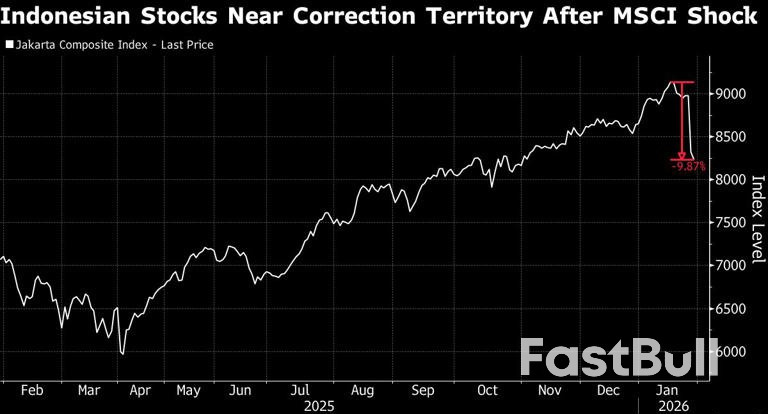
Indonesian Stocks Near Correction Territory After MSCI Shock
Thursday’s losses put benchmark stocks just shy of a technical correction. It marks a dramatic turn for the Jakarta Composite Index, which had reached a record closing high last week.
The angst also hit the local currency, with the rupiah down as much as 0.5% against the dollar, its biggest fall since October, before paring while benchmark yields were a touch higher.
“The tail risk I am watching out for is how this will impact the currency, and what that means for the central bank and its options for monetary policy this year,” said Yiping Liao, portfolio manager at Franklin Templeton Global Investments. “But the correction over the past two days is certainly more violent than expected.”
Earlier in the day, Goldman Sachs Group Inc. and UBS AG both cut their recommendations, with the former adding that more than $13 billion in outflows could be triggered in an extreme scenario.
At the heart of the concerns is the low free float of Indonesian equities, with the market’s biggest companies thinly traded and controlled by a handful of wealthy individuals — a structure that investors say distorts the index and risks manipulation.
Indonesian regulators have pledged to meet the call for greater transparency, and have until May when the index compiler reassesses the country’s market accessibility status. If MSCI deems there’s not enough progress, it could reduce Indonesia’s weighting in its indexes and even downgrade the nation from emerging market.
A reclassification would put Indonesia in the same place as Pakistan, which lost its emerging-market status in 2021 just four years after it was upgraded due to shrinking market size and liquidity.
This week’s selloff traces back to months of consultations after MSCI proposed to tighten the definition of free float last year. The firm had said it was considering an alternative data source, the Indonesia Central Securities Depository, also known as KSEI, to assess actual tradable shares. But in its statement on Wednesday, MSCI said that many investors raised “significant concerns” about relying on this data set.
“Based on what’s been disclosed so far, the discussion around KSEI has mainly been about concerns over aspects of its data methodology, but there hasn’t been enough detail to draw firm conclusions yet,” said Bloomberg Intelligence Strategist Sufianti. “So for now, it’s very much a wait-and-see in terms of what actions might follow.”
Across Asia Pacific, Indonesia has the lowest average free float among major markets with a minimum of 7.5%, compared with minimums of 25% in Hong Kong and India, and 15% in Thailand.
Even before this week’s rout, foreign investors had already turned cautious, selling a net $192 million worth of stocks in the week ended Jan. 23, which was the first outflow in 16 weeks. Overseas investors offloaded a net 6.2 trillion rupiah ($371 million) of local shares Wednesday, the most since April 16, according to exchange data.
Source: Bloomberg
Copyright © 2026 FastBull Ltd
News, historical chart data, and fundamental company data are provided by FastBull Ltd.
Risk Warnings and Disclaimers
You understand and acknowledge that there is a high degree of risk involved in trading. Following any strategies or investment methods may lead to potential losses. The content on the site is provided by our contributors and analysts for information purposes only. You are solely responsible for determining whether any trading assets, securities, strategy, or any other product is suitable for investing based on your own investment objectives and financial situation.


