

Has bitcoin already peaked, or is one last surge ahead?
 Adam
AdamSummary:
Bitcoin’s four-year cycle nears its end, with analysts divided: some expect one last rally toward $180K–$250K, while others see October’s $126K peak as the top amid outflows and tightening liquidity.
The price journey of bitcoin has long followed a four-year rhythm tied to its halving events. Historically, BTC starts appreciating roughly a year before each halving, driven by the anticipation that supply scarcity will boost its value. About eighteen months later, it typically reaches a new all-time high before entering a sharp six-month correction, followed by a year-long bear market. This is a broad pattern with variations, yet since bitcoin’s inception in 2009, the sequence has repeated with striking regularity.
With the last halving taking place in April 2023, the current cycle suggests that a new peak should arrive around October–November 2025. However, an increasing number of analysts are questioning whether Bitcoin still has one last leg up — or if the previous high of $126,300 on October 6 already marked the top, setting the stage for the next downturn.
One last push for bitcoin
Several arguments still favor one more significant leg higher before this cycle ends.
One of the most important — at least psychologically — is Bitcoin’s underwhelming performance compared with past cycles. Since the last cycle low of $15,450 in November 2022, BTC has gained “only” 660%. At this point in previous cycles, the asset had rallied 1,980% and 9,645% respectively. The slowdown is perfectly natural for a maturing asset, yet it leaves many investors feeling that this cycle remains unfinished.
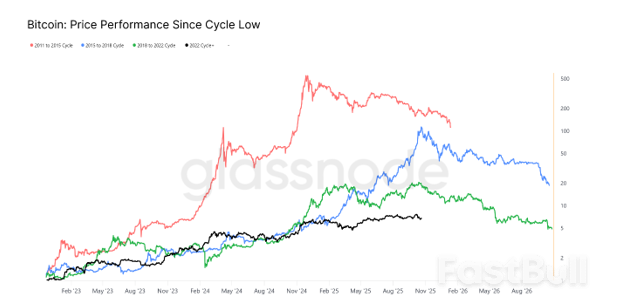
Market expectations reinforce that view. Numerous analysts, consulting firms and even major banks have projected Bitcoin reaching between $180,000 and $250,000 by the end of 2025 — a target still anchored in collective memory.
Gold’s recent behavior also adds weight to the bullish case. As analyst Colin Talks Crypto noted, over the past months, gold has surged to catch up with global M2, while Bitcoin has lagged behind. Historically, , BTC tends to follow gold’s moves with a delay, which could indicate that it could close the gap with gold any time soon.
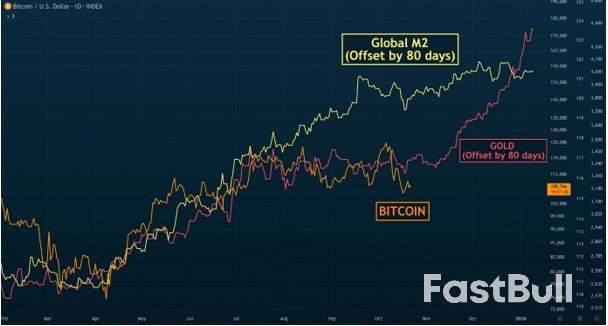
Timing also supports the possibility of one last rally. Historically, Bitcoin bull runs often accelerate during their final months. Though this cycle’s structure may differ from previous ones, a final surge remains plausible — especially if macro conditions improve.
Is the top already in?
Yet there are several red flags indicating that the bull market may in fact be ending.
Veteran trader Peter Brandt warned that Bitcoin was tracing a “broadening top” — a pattern famous for marking cycle peaks. He compared the current setup to the 1970 soybean bubble, which declined 50% after completing a similar formation.
Fund flows are already turning negative. According to Coinshares, bitcoin ETFs recorded $946 million in outflows last week, ending a two-week inflow streak. Persistent outflows often signal fading confidence among professional investors.
Macro risks loom larger for bitcoin, too. Famous analyst Willy Woo argues unlike previous halving-driven bear markets, the next downturn will be defined by another cycle people forget about — the business cycle. He notes: “We had two 4-year cycles superimposed. Now it’s only one: global M2 liquidity.” Woo points out that the last major business-cycle contractions — in 2001 and 2008 — occurred before Bitcoin existed. If global liquidity tightens or recession pressure builds, BTC could behave more like a high-beta risk asset than a store of value.
A cycle in its final act
Bitcoin’s current cycle now stands at a crossroads. Either it mounts one last rally toward higher highs before rolling over — or October’s $126,300 peak was the top, ushering in a drawn-out distribution and decline.
The next 2–5 weeks could prove decisive. A convincing break above $116,000, renewed ETF inflows, or a macro surprise — such as a major rate cut or an easing of U.S.–China trade tensions — could spark the final thrust higher. Conversely, failure to hold $107,000, continued ETF outflows, or worsening macro sentiment could confirm that the cycle’s climax has already passed.
Whether the bull market ends in euphoria or quiet exhaustion, this phase marks the closing act of Bitcoin’s four-year rhythm — and the opening scene of whatever comes next.
Source: marketscreener
Copyright © 2026 FastBull Ltd
News, historical chart data, and fundamental company data are provided by FastBull Ltd.
Risk Warnings and Disclaimers
You understand and acknowledge that there is a high degree of risk involved in trading. Following any strategies or investment methods may lead to potential losses. The content on the site is provided by our contributors and analysts for information purposes only. You are solely responsible for determining whether any trading assets, securities, strategy, or any other product is suitable for investing based on your own investment objectives and financial situation.


