
BeeMarkets
BeeMarkets
Pioneering AI Broker: Lowest Spreads & Commissions
Home
Trade
Trading Environment
Spread Commission
Account
Account Type
Overview Standard Account Expert Account Pro Account Corporate Account
Manage Account
Deposits & Withdrawals
Market
Market
Forex Metal EnergyIndices Crypto
Platform
FastBull
Overview FastBull Web FastBull App
BeeMarkets
OverviewBeeMarkets App
Resources
News & Education
Market News 24/7 Economic Calendar Video
Trading tools
Currency Converter Margin Calculator Swap Calculator P/L Calculator
More
About Us
Why Us Contact BeeMarkets BM AI Help Center Term and Policy
Sign Up
Log In

English

Español

العربية

Bahasa Indonesia

Bahasa Melayu

Tiếng Việt

ภาษาไทย

Русский язык

Français

Italiano

Turkish

Português

日本語

한국어

简中

繁中

English
Language
  • Home
  • Trade
    • Trading Environment
    • Spread
    • Commission
  • Account
    • Account Type
    • Overview
    • Standard Account
    • Expert Account
    • Pro Account
    • Corporate Account
    • Deposits & Withdrawals
  • Market
    • Market
    • Forex
    • Metal
    • Energy
    • Indices
    • Crypto
  • Platform
    • FastBull
    • Overview
    • FastBull Web
    • FastBull App
    • BeeMarkets
    • Overview
    • BeeMarkets App
  • Resources
    • News & Education
    • Market News
    • 24/7
    • Economic Calendar
    • Video
    • Trading tools
    • Currency Converter
    • Margin Calculator
    • Swap Calculator
    • P/L Calculator
  • More
    • About Us
    • Why Us
    • Contact BeeMarkets
    • BM AI
    • Help Center
    • Term and Policy

English

Español

العربية

Bahasa Indonesia

Bahasa Melayu

Tiếng Việt

ภาษาไทย

Русский язык

Français

Italiano

Turkish

Português

日本語

한국어

简中

繁中

Sign Up Log In

Global Trade's Quiet Pivot From the US Market

George Anderson
Summary:

US allies, prompted by tariffs, are strategically "de-risking" trade, forging new global pacts.
While America's military and technological dominance remains unchallenged, a subtle but significant shift is reshaping the global trade landscape. Prompted by President Donald Trump's affinity for tariffs, U.S. allies are discovering they have more options than previously thought in the trade of goods, and they are adapting with surprising speed.

This isn't a dramatic decoupling. No one is seriously attempting to abandon the U.S., which is still the world's most lucrative market. Instead, a recent wave of bilateral pacts signals a more measured strategy: "de-risking." This term, once primarily used in discussions about China, now applies to hedging against unpredictability from Washington.

Pursuing this strategy comes with costs, from reconfiguring supply chains to forging alliances with nations that don't share identical values. However, early indicators suggest the economic price of this insurance policy is manageable.

The New "De-Risking" Playbook

"Trade is probably one of the areas where middle powers have some of the greatest agency in choices," notes Alexander George, senior director for geopolitics at the Tony Blair Institute for Global Change (TBI).

He points to the European Union as a prime example. The threat of U.S. trade actions appeared to galvanize the bloc, leading to the recent signing of the long-stalled EU-Mercosur trade deal with Latin American countries and a new agreement with India.

Of course, these deals face political and legal hurdles. The EU's ability to ratify the Mercosur pact will be a key test of its resolve. Similarly, recent efforts by British and Canadian leaders to mend ties with China are in their early stages, though some initial deals have already been made.

How Businesses Are Reshaping Supply Chains

Businesses aren't waiting for governments to draw a complete map of the new trade order. The Irish Whiskey Association, for example, celebrated the EU-India deal as a "critical" move to find new customers and offset the impact of a 15% U.S. tariff on its largest market.
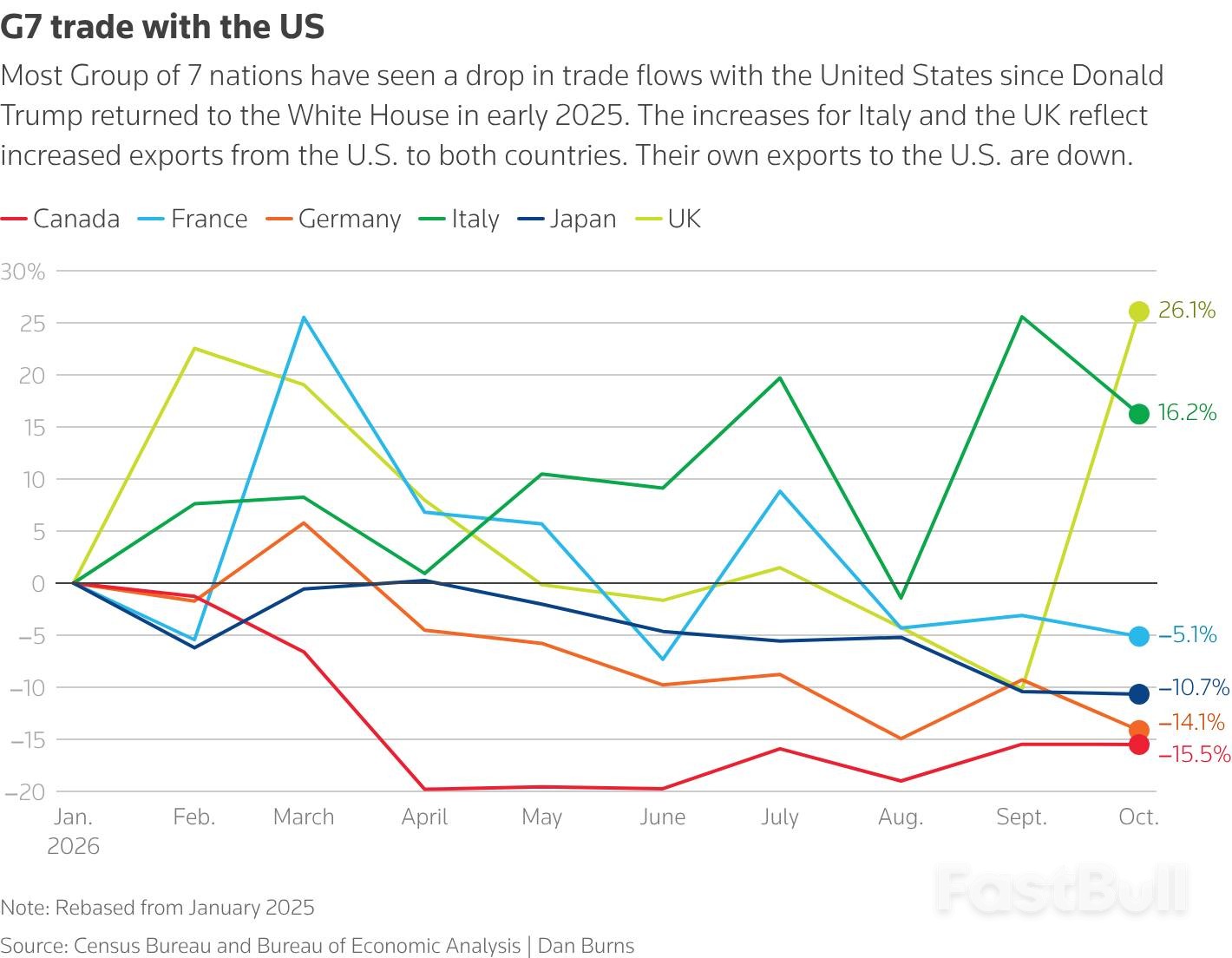
Figure 1: G7 trade flows with the United States show a clear divergence in 2026, with countries like Canada and Germany seeing significant declines while Italy and the UK increased their trade, illustrating the complex realignment of global commerce.

Meanwhile, German corporate investment in China reached a four-year high last year. According to the IW German Economic Institute, this was partly driven by a need to build local supply chains in response to a more challenging U.S. trade environment.

Despite the turbulence, the global economy has remained resilient. A quarterly Reuters poll of 220 economists showed that the forecast for global economic growth this year remains at 3%, unchanged from a year ago, even with supply chain adjustments underway.

Some experts see long-term benefits in this restructuring. World Trade Organization Director-General Ngozi Okonjo-Iweala told Reuters that diversifying investment and production builds global resilience and creates jobs. This aligns with Canadian Prime Minister Mark Carney's call for "middle powers" to build a network of alliances among themselves.

The Cost of Confrontation

For most nations, diversification is a safer bet than direct confrontation with the United States.

Modeling from the UK's Aston University found that if tensions over Greenland had escalated, a threatened 25% U.S. tariff would have cost European economies only 0.26% of per capita income if they chose not to retaliate. In contrast, a retaliatory 25% levy on U.S. goods would have more than doubled that cost.

Mujtaba Rahman, managing director for Europe at Eurasia Group, notes that forging new trade alliances abroad can be politically easier for governments than implementing difficult domestic economic reforms. "Diversification on the trade side is absolutely happening and continuing," he said of Europe.

Limits to the Global Trade Realignment

Two key factors could limit the pace and scope of this global adaptation.

First, China's reluctance to stimulate domestic consumer demand means it cannot easily absorb the slack from the U.S. market. The Tony Blair Institute observed that while China's exports have grown since the implementation of higher U.S. tariffs, its imports have stayed flat, forcing other nations to accept widening trade deficits with Beijing.

Second, the United States may actively discourage countries from pursuing diversification strategies that pull them out of its economic orbit. "The question is to what extent this becomes a geopolitical faultline," said TBI's George, highlighting the risk of trade shifts escalating into broader strategic tensions.

To stay updated on all economic events of today, please check out our Economic calendar
Copyright © 2026 FastBull Ltd
News, historical chart data, and fundamental company data are provided by FastBull Ltd.
Risk Warnings and Disclaimers
You understand and acknowledge that there is a high degree of risk involved in trading. Following any strategies or investment methods may lead to potential losses. The content on the site is provided by our contributors and analysts for information purposes only. You are solely responsible for determining whether any trading assets, securities, strategy, or any other product is suitable for investing based on your own investment objectives and financial situation.
BeeMarkets
InstagramTwitterfacebooklinkedin
App Store Google Play
Trade
Trading Environment
Spread
Commission
Account
Account Type
Overview
Standard Account
Expert Account
Pro Account
Corporate Account
Manage Account
Deposits & Withdrawals
Market
Market
Forex
Metal
Energy
Indices
Crypto
Platform
FastBull
Overview
FastBull Web
FastBull App
BeeMarkets
Overview
BeeMarkets App
Resources
News & Education
Market News
24/7
Economic Calendar
Video
Trading tools
Currency Converter
Margin Calculator
Swap Calculator
P/L Calculator
More
About Us
Why Us
Contact BeeMarkets
BM AI
Help Center
Term and Policy

BEE SOUTH AFRICA (PTY) LTD is a broker registered in South Africa with registration number 2025 / 325303 / 07. Its registered address is:21 Villa Charlise, Edgar Road, Boksburg, Boksburg, Boksburg, Gauteng, 1459.BEE SOUTH AFRICA (PTY) LTD is an affiliated entity of Bee (COMOROS) Ltd, and the two operate independently.

BEEMARKETS SECURITIES & FINANCIAL PRODUCTS PROMOTION L.L.C is a broker registered in the United Arab Emirates with registration number 1471759. Its registered address is:Office No. 101, Property of Sheikh Ahmed Bin Rashid Bin Saeed Al Maktoum, Deira, Hor Al Anz.BEEMARKETS SECURITIES & FINANCIAL PRODUCTS PROMOTION L.L.C is an affiliated entity of Bee (COMOROS) Ltd, and the two operate independently.

Risk Disclosure:OTC derivative contracts, such as Contracts for Difference (CFDs) and leveraged foreign exchange (FX), are complex financial instruments carrying significant risks. Leverage can lead to rapid losses, potentially exceeding your initial investment, making these products unsuitable for all investors. Before trading, carefully evaluate your financial position, investment goals, and risk tolerance. We strongly recommend consulting independent financial advice if you have any doubts about the risks involved.

BeeMarkets does not guarantee the accuracy, timeliness, or completeness of the information provided here, and it should not be relied upon as such. The content—whether from third parties or otherwise—is not a recommendation, offer, or solicitation to buy or sell any financial product, security, or instrument, or to engage in any trading strategy. Readers are advised to seek their own professional advice.

Jurisdictional Restrictions:BeeMarkets does not offer services to residents of certain jurisdictions, including the United States, Mainland China, Australia, Iran, and North Korea, or any region where such services would violate local laws or regulations. Users must be 18 years old or of legal age in their jurisdiction and are responsible for ensuring compliance with applicable local laws. Participation is at your own discretion and not solicited by BeeMarkets. BeeMarkets does not guarantee the suitability of this website’s information for all jurisdictions.

Risk Disclosure Anti-Money Laundering Privacy Policy
Copyright © 2026 BeeMarkets, All Rights Reserved