

Crypto Fear and Greed Index: How to Read Market Sentiment
 zhan chen
Learn how the Crypto Fear and Greed Index works, what its 0–100 score means, and how to use fear and greed signals when analyzing Bitcoin and crypto markets.
The Crypto Fear and Greed Index shows whether cryptocurrency investors are fearful, confident, or somewhere in between. When Bitcoin prices move sharply, the index helps explain market sentiment. But does extreme fear signal a buying opportunity, or can prices fall further?
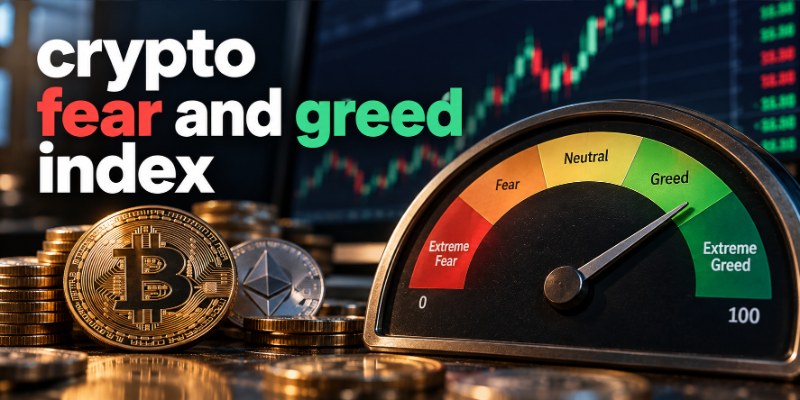
Table of Contents
- 1. What Is the Crypto Fear and Greed Index?
- 2. Crypto Fear and Greed Index Today: How to Read the Current Score
- 3. How Is the Crypto Fear and Greed Index Calculated?
- 4. How to Use the Crypto Fear and Greed Index in Trading
- 5. Crypto Fear and Greed Index vs. Other Market Indicators
- 6. Does the Crypto Fear and Greed Index Predict Bitcoin Prices?
- 7. What Are the Limitations of the Crypto Fear and Greed Index?
- 8. Is the Crypto Fear and Greed Index Worth Following?
- 9. FAQs About the Crypto Fear and Greed Index
What Is the Crypto Fear and Greed Index?
The Crypto Fear and Greed Index measures cryptocurrency market sentiment on a scale from 0 to 100. Lower scores indicate fear, while higher scores indicate greed.
The best-known version comes from Alternative.me and primarily tracks Bitcoin sentiment rather than every cryptocurrency equally.
Sharp price declines can trigger pessimism, while rapid rallies often fuel excitement and fear of missing out (FOMO). Neither guarantees the next price movement, but both reveal how investors are reacting.
Crypto Fear and Greed Index Scale Explained
The index divides sentiment into five categories.
| Index Score | Sentiment | What It Suggests |
|---|---|---|
| 0–24 | Extreme Fear | Strong pessimism and risk aversion |
| 25–49 | Fear | Investors remain cautious |
| 50 | Neutral | Neither fear nor greed dominates |
| 51–74 | Greed | Growing optimism and risk appetite |
| 75–100 | Extreme Greed | Strong enthusiasm and possible overheating |
These scores describe sentiment, not valuation. A reading of 15 does not prove Bitcoin is cheap, just as 85 does not guarantee a correction.
Crypto Fear and Greed Index Today: How to Read the Current Score
The index changes daily, making live readings more useful than outdated figures. Check the latest score, historical values, and chart on the official Crypto Fear and Greed Index page.
What Does a Low Fear and Greed Index Mean?
A low score indicates concern about falling prices, economic uncertainty, or unfavorable developments. Extreme fear commonly accompanies sell-offs, liquidations, and reduced risk appetite.
If Bitcoin falls while the index drops from 45 to 18, sentiment has deteriorated significantly. That may interest patient investors, but fear can persist throughout a bear market. A low score cannot identify the bottom.
What Does a High Fear and Greed Index Mean?
High readings reflect optimism, often driven by rising prices and stronger trading activity.
Extreme greed can increase vulnerability to profit-taking or corrections. However, bullish markets may remain in greed territory for weeks. Selling solely because the index reaches 80 could mean exiting too early.
Why the Trend Matters More Than One Reading
Changes over several days or weeks provide more context than one score.
- Fear rises from 15 to 35: Sentiment improves, although caution remains.
- Greed falls from 85 to 60: Optimism cools but remains positive.
- Fear stays below 25 for weeks: Uncertainty may be prolonged rather than temporary.
Compare these changes with Bitcoin prices, trading volume, and broader conditions.
How Is the Crypto Fear and Greed Index Calculated?
Alternative.me combines market behavior and sentiment indicators using published factor weights. It does not simply count bullish and bearish opinions.
Main Factors Behind the Index
| Factor | Published Weight | What It Measures |
|---|---|---|
| Volatility | 25% | Current Bitcoin volatility and drawdowns relative to historical averages |
| Market Momentum and Volume | 25% | Trading activity and market momentum compared with historical levels |
| Social Media | 15% | Engagement and sentiment-related activity on social platforms |
| Surveys | 15% | Investor sentiment surveys; currently paused |
| Bitcoin Dominance | 10% | Changes in Bitcoin's share of the cryptocurrency market |
| Trends | 10% | Search interest in Bitcoin-related topics |
Source: Alternative.me's published methodology. Surveys are currently paused, so the listed weights do not necessarily represent every active daily calculation.
Volatility and Market Momentum
Sharp declines and unusually high volatility often reflect fear. Strong buying activity and momentum can indicate growing risk appetite, while weakening momentum suggests fading confidence.
Together, these factors help distinguish ordinary price fluctuations from emotionally driven trading.
Social Media, Search Trends, and Bitcoin Dominance
Social engagement and Google search trends can reveal growing excitement or concern around Bitcoin.
Bitcoin dominance measures its share of the overall crypto market. Investors sometimes favor Bitcoin over smaller tokens during uncertainty, although rising dominance can also reflect Bitcoin outperforming rather than widespread fear.
How to Use the Crypto Fear and Greed Index in Trading
The index works best alongside price analysis and risk management, not as a standalone trading signal.
1. Look for Extreme Sentiment
Extreme readings can indicate one-sided expectations. Fear may drive aggressive selling, while greed can encourage buyers to chase rallies without considering downside risk.
When most investors expect the same outcome, markets can become vulnerable to reversals. Still, extreme sentiment is a reason to investigate, not an automatic trade signal.
2. Compare Sentiment With Bitcoin Price Action
If Bitcoin keeps making lower lows while the index stays near 20, weakness remains evident.
If Bitcoin begins holding support, selling volume declines, and sentiment improves toward neutral, stabilization becomes more plausible.
Traders can also examine the Relative Strength Index (RSI), moving averages, and support or resistance levels to see whether indicators agree.
3. Use Sentiment to Manage Risk
During extreme greed, investors with substantial unrealized gains might review concentration or rebalance. During extreme fear, long-term investors could consider gradual purchases rather than attempting to time the bottom.
Neither approach requires an all-or-nothing decision.
4. Avoid Treating Extreme Fear as an Automatic Buy Signal
Fear can remain elevated while prices continue falling. Similarly, extreme greed can persist throughout strong rallies.
Combine sentiment with price trends, liquidity, macroeconomic developments, and a defined risk-management plan.
Crypto Fear and Greed Index vs. Other Market Indicators
The Fear and Greed Index measures market psychology, while other indicators examine momentum, trends, or trading activity.
| Indicator | Main Purpose | Key Limitation |
|---|---|---|
| Crypto Fear and Greed Index | Measures overall Bitcoin-focused sentiment | Does not predict price direction |
| Relative Strength Index (RSI) | Measures price momentum | Can remain overbought or oversold |
| Moving Averages | Identify trend direction | React after price movements |
| Trading Volume | Measures market participation | High volume can accompany buying or selling |
| Funding Rates | Show positioning pressure in perpetual futures | Vary across exchanges and contracts |
For example, extreme greed alongside strong RSI momentum and increasing volume suggests enthusiasm, but not necessarily an imminent reversal.
Likewise, extreme fear with declining selling pressure may warrant attention, although confirmation remains important.
Does the Crypto Fear and Greed Index Predict Bitcoin Prices?
No—not reliably on its own. The index partly reacts to price movements that have already happened. It describes current sentiment more effectively than it forecasts Bitcoin's next move.
Can Extreme Fear Signal a Market Bottom?
Extreme fear has appeared near important market lows. During the 2022 crypto downturn, sentiment remained deeply negative amid Bitcoin losses and major industry failures.
However, prices did not recover immediately. Extreme pessimism can accompany attractive long-term opportunities or appear well before a lasting bottom.
Can Extreme Greed Signal a Market Top?
Extreme greed often accompanies speculative rallies, but elevated optimism can last for months.
A high reading suggests possible correction risk without providing reliable timing. Weakening momentum or broken support may offer more actionable evidence.
What Are the Limitations of the Crypto Fear and Greed Index?
The index has several important limitations.
First, it is Bitcoin-focused. Ethereum, smaller altcoins, and individual sectors may experience different sentiment.
Second, it is partly reactive. Price declines can trigger fear readings after substantial losses have already occurred.
Third, it cannot capture every market force. Regulation, institutional flows, exchange failures, and economic surprises can overwhelm sentiment signals.
Fourth, it does not directly measure every investor's positioning. Its selected inputs provide an estimate rather than a complete real-time picture.
For broader context, investors can review market capitalization, trading activity, and Bitcoin dominance on CoinGecko.
Is the Crypto Fear and Greed Index Worth Following?
Yes. The index offers a straightforward way to monitor changes in cryptocurrency sentiment and recognize periods of unusual anxiety or optimism.
However, sentiment does not determine valuation or future returns. Its greatest value comes from tracking changes over time alongside price action, liquidity, and economic conditions.
Extreme fear is a reason to investigate opportunities, while extreme greed is a reason to reassess risk—not a guarantee of reversal.
FAQs About the Crypto Fear and Greed Index
What is a good Crypto Fear and Greed Index score?
There is no universally good score. Low readings indicate pessimism and potential opportunities, while high readings suggest optimism and possibly elevated risk.
How often is the Crypto Fear and Greed Index updated?
The Alternative.me index updates daily, with current and historical readings available on its official website.
Is the Crypto Fear and Greed Index only for Bitcoin?
Alternative.me's index primarily tracks Bitcoin sentiment, although investors often use it as a broader cryptocurrency market reference.
Should I buy crypto when the Fear and Greed Index is low?
Not based on sentiment alone. Consider market trends, fundamentals, liquidity, and your investment horizon.
Is extreme greed a sell signal?
Not necessarily. Extreme greed may precede corrections but can also persist during strong bull markets.


