

Crypto Downturn Wipes Out Nearly $1 Billion in Levered Bets
 Manuel
Summary:
The crypto market is on shaky ground after a weeks-long selloff that began when some $19 billion in levered bets were wiped out in early October as President Donald Trump whipsawed markets with threats of higher tariffs.
Nearly $1 billion of leveraged crypto positions were liquidated during another sharp drop in prices on Monday that brought fresh momentum to a wide-ranging selloff that has carried into a third month.
Bitcoin slid as much as 8% to $83,824 in New York, bringing its decline for the year to more than 9%. Ether dropped 10% to as low as $2,719, and is down 18% since last December. The market downturn has been even tougher on smaller, less liquid tokens that traders often gravitate toward because of their higher volatility and typical outperformance during rallies. A MarketVector index tracking the bottom half of the largest 100 digital assets is down almost 70% this year.
The crypto market is on shaky ground after a weeks-long selloff that began when some $19 billion in levered bets were wiped out in early October as President Donald Trump whipsawed markets with threats of higher tariffs, data compiled by tracker Coinglass show. That was just days after Bitcoin set an all-time high of $126,251. The automated closing of leveraged positions in crypto, such as the major event on Oct. 10, is sometimes referred to as a liquidation cascade.
Traders use liquidation data to assess leverage in the system, spot risk appetite, and gauge whether a market wipeout has truly cleansed excess speculation. But the numbers they rely on may be incomplete. Industry insiders have said exchanges restrict the full liquidation data they share, making it hard for traders to know how much leverage is truly in the system.
“It’s a risk off start to December,” said Sean McNulty, APAC derivatives trading lead at FalconX. “The biggest concern is the meagre inflows into Bitcoin exchange traded funds and absence of dip buyers. We expect the structural headwinds to continue this month. We are watching $80,000 on Bitcoin as the next key support level.” 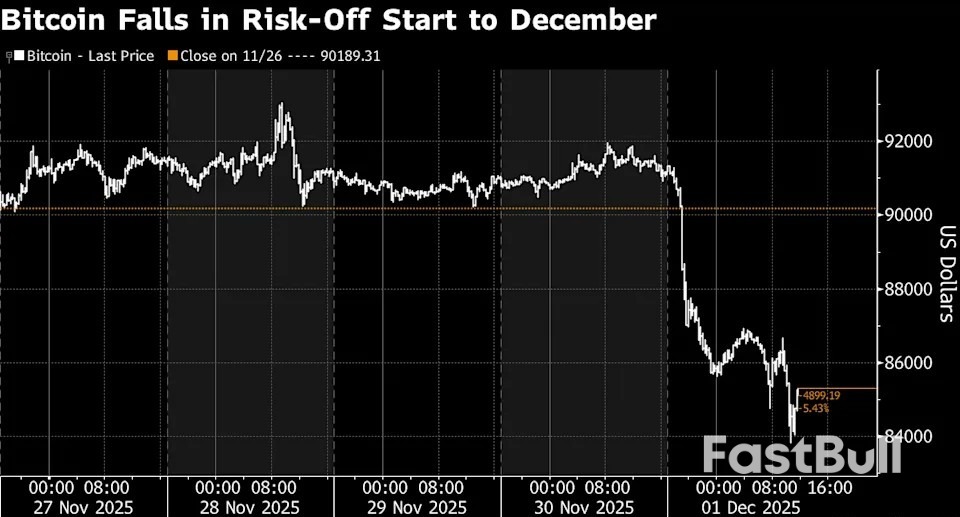
Digital assets also felt the broader macro shifts rippling through global markets, as equity traders in the US start the week on the backfoot. Japanese stocks fell and the yen rose as Bank of Japan Governor Kazuo Ueda sent the clearest hint yet of a rate hike this month.
“As December kicks off, investors are focused on the path forward for global monetary policy,” said Karim Dandashy, an over-the-counter trader at crypto trading firm Flowdesk. “With the Fed now expected to be cutting again after a brief panic last week that saw December odds drop to 30%, and now the BOJ looking more likely to be raising rates to counter the moves we’ve seen in JGBs.”
On Monday, Michael Saylor’s Strategy Inc. said it had created a $1.4 billion reserve to fund future dividend and interest payments, in a bid to temper fears that the Bitcoin accumulator may be forced to sell some of its roughly $56 billion cryptocurrency haul if token prices continue to fall.
The company’s mNAV — a key valuation metric comparing the firm’s enterprise value to the value of its Bitcoin holdings — sat at about 1.11 on Monday, according to its website, spurring investor fears it may soon turn negative. If that were to happen, its CEO Phong Le had suggested last week that the firm could sell some of its Bitcoin. Shares of Strategy tumbled more than 10% on Monday, and are now down around 66% since reaching an all-time high in November 2024.
Meanwhile, US spot Bitcoin ETFs took in a modest $70 million last week, after roughly $4.6 billion in outflows over the past month, Bloomberg data show. Most of the pressure has come from the iShares Bitcoin Trust, where investors have pulled money for five straight weeks, the longest withdrawal streak since the fund launched in January 2024.
The week ahead is set to offer a crucial snapshot of US economic momentum as policymakers weigh the trajectory of interest rates heading into 2026. Data is likely to shape expectations for whether the Federal Reserve continues its rate-cutting cycle. US President Donald Trump on Sunday said he had decided on his pick for the next Fed chair, after making clear he expects his nominee to deliver interest-rate cuts.
Meanwhile, S&P Global Ratings last week downgraded an assessment of the stability of USDT, the world’s largest stablecoin, to its lowest rating, warning that a drop in Bitcoin’s value could leave the token undercollateralized. Further uncertainty came from the People’s Bank of China, which on Saturday issued a warning about the risks of virtual currencies including stablecoins, adding that government agencies should deepen coordination to crack down on illegal activities.
However, Flowdesk’s Dandashy added that there seems to be “a light at the end of the tunnel” as the market enters the end of the year.
“Whether economic data can get in the way of those expectations right now seems to be most important for a year end risk rally,“ he said.
Source: Bloomberg
Copyright © 2025 FastBull Ltd
News, historical chart data, and fundamental company data are provided by FastBull Ltd.
Risk Warnings and Disclaimers
You understand and acknowledge that there is a high degree of risk involved in trading. Following any strategies or investment methods may lead to potential losses. The content on the site is provided by our contributors and analysts for information purposes only. You are solely responsible for determining whether any trading assets, securities, strategy, or any other product is suitable for investing based on your own investment objectives and financial situation.


