

Broadcom shares slide after investors seek bigger AI payoff
 Adam
AdamSummary:
Broadcom shares fell as investors questioned the timing and profitability of its AI push, disappointed by limited guidance, margin pressure warnings, and a vague outlook despite strong earnings and rising AI demand.
Broadcom Inc., a chip company vying with Nvidia Corp. for AI computing revenue, slumped after its sales outlook for the red-hot market failed to meet investors’ lofty expectations.
The shares fell about 5% in premarket trading on Friday, following unsettling commentary from Chief Executive Officer Hock Tan on a conference call with analysts. He said the company has a backlog of $73 billion in AI product orders that will be shipped over the next six quarters — a number that disappointed some investors. But Tan sought to clarify that the figure was a “minimum.”
“We do expect much more as more orders come in for shipments within that next six quarters,” he said. “So our lead time, depending on the particular product it is, can be anywhere from six months to a year.”
The conference call followed a dizzying run-up in Broadcom shares, and investors were seeking more clarity on when and how the company will get a payoff from AI. Instead, they got a vague timetable without an AI revenue forecast for 2026 — mixed with some concerns about tightening profit margins.
Though Tan said that the company received an $11 billion order from AI startup Anthropic PBC in the fourth quarter, he warned that total margins were narrowing because of AI product sales.
Broadcom also held off on giving an annual AI revenue forecast, with Tan saying it was “a moving target.”
“It’s hard for me to pinpoint what ’26 is going to look like precisely,” he said. “So I’d rather not give you guys any guidance.”
The call followed a generally upbeat earnings report on Thursday afternoon. Sales will be about $19.1 billion in the fiscal first quarter, which ends Feb. 1, the company said. Analysts had estimated $18.5 billion on average, according to data compiled by Bloomberg. The company also boosted its quarterly dividend 10% to 65 cents a share.
The $11 billion Anthropic order in the fourth quarter followed a $10 billion deal in the third, he said. Broadcom also signed another customer order worth $1 billion, Tan said, without identifying the client.
Broadcom has benefited from demand for its custom chips as part of a massive data center build-out, giving it a growing piece of an industry dominated by Nvidia.
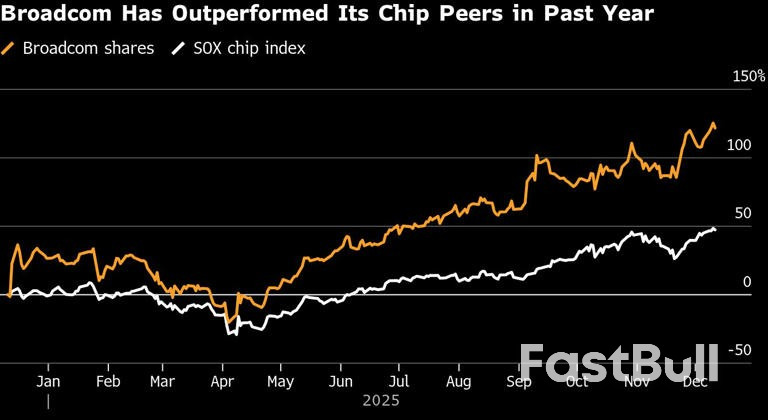
Broadcom Has Outperformed Its Chip Peers in Past Year
an said that AI semiconductor revenue would double to $8.2 billion in the first quarter, compared with a year earlier.
Much of the recent buzz around Broadcom stems from its ties to some of the biggest AI model providers. ChatGPT maker OpenAI signed a pact with Broadcom for its own AI chip designs. In another transaction, Anthropic agreed to use tens of billions of dollars’ worth of computing services based on Alphabet Inc.’s Google Cloud TPUs. The latter components also rely on Broadcom designs, helping fuel investor enthusiasm about the chipmaker’s AI prospects.
Broadcom shares had earlier closed at $406.37 in New York, leaving them up 75% this year.
The Palo Alto, California-based company has a wide-ranging lineup that spans communications chips, networking components and software.
As part of its bid to generate greater revenue from AI, Broadcom has been updating its networking equipment to move data more quickly inside and between data centers. With AI models getting more complex, the ability to connect chips, racks of servers and whole buildings is growing more critical.
In the fiscal fourth quarter, which ended Nov. 2, Broadcom posted sales of $18 billion. Earnings rose to $1.95 a share, excluding some items. Analysts had estimated revenue of $17.5 billion and profit of $1.87 a share.
As part of Broadcom’s OpenAI deal, announced in October, the ChatGPT maker will use custom chips and networking components to help power its artificial intelligence services.
The deal will bring in additional revenue to Broadcom’s custom chip unit and provide deeper access to the booming AI market. Though the company has already seen its revenue from artificial intelligence computing climb, Broadcom has remained in the shadow of Nvidia, the top seller of AI processors.
Tan, the CEO, stands to benefit handsomely if that business meets long-term financial goals. The executive is due to get 610,521 shares of Broadcom if AI revenue hits $90 billion by fiscal 2030. If the sales reach $120 billion, Tan is poised for 300% of the payout.
Source: Bloomberg
Copyright © 2025 FastBull Ltd
News, historical chart data, and fundamental company data are provided by FastBull Ltd.
Risk Warnings and Disclaimers
You understand and acknowledge that there is a high degree of risk involved in trading. Following any strategies or investment methods may lead to potential losses. The content on the site is provided by our contributors and analysts for information purposes only. You are solely responsible for determining whether any trading assets, securities, strategy, or any other product is suitable for investing based on your own investment objectives and financial situation.


