

Bitcoin Jumps on Fed News, But Key Metrics Flash Warning
 Patrick Turner
Bitcoin briefly topped $92,000 on Fed probe news, but ETF outflows and weak sentiment challenge its safe-haven narrative.
Bitcoin briefly climbed above $92,000 after news broke that U.S. federal prosecutors have opened a criminal investigation into Federal Reserve Chair Jerome Powell. Despite this seemingly bullish catalyst, traders remain skeptical, pointing to significant outflows from Bitcoin ETFs and weak demand for leveraged long positions.
Two key indicators highlight the market's cautious sentiment:
• Institutional Selling: Bitcoin ETFs have recorded $1.38 billion in net outflows across just four trading sessions, signaling that major players are selling.
• Weak Bullish Momentum: Data from BTC futures shows a neutral 5% basis rate, well below the 10% premium that typically indicates strong bullish sentiment.
Bitcoin Lags Gold as Safe-Haven Narrative Wavers
While Bitcoin has shown some resilience, it has significantly underperformed precious metals. The cryptocurrency is still down 23% since October 2025, a period during which both gold and silver reached all-time highs in 2026. This stark divergence has led traders to question whether Bitcoin's narrative as a digital store of value is losing its strength.
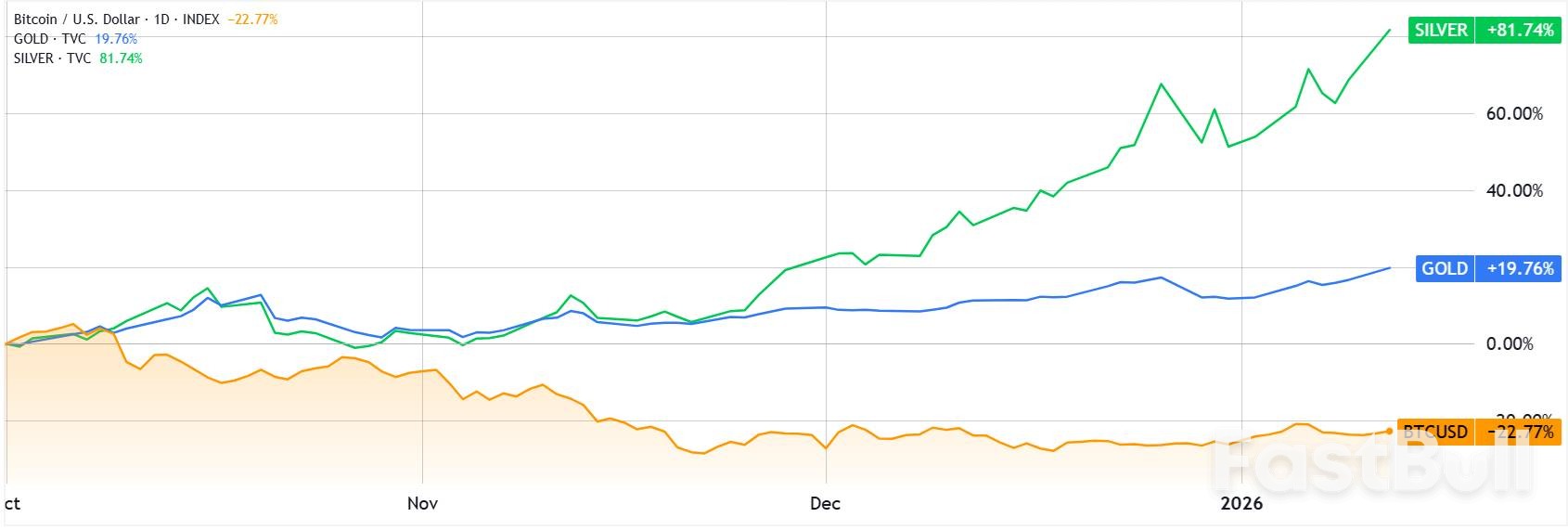
A comparison of Bitcoin, Gold, and Silver performance shows a significant divergence, with Silver gaining 81.74% and Gold rising 19.76% while Bitcoin fell 22.77% since October 2025.
As a result, even if Bitcoin manages another 14% rally toward the $105,000 level, investors may remain hesitant to adopt a bullish stance. This caution is amplified as analysts become less confident that the U.S. will introduce further economic stimulus in the near future.
Fed Turmoil and a Shifting Monetary Outlook
Adding to the complex economic picture, Goldman Sachs has revised its forecast and no longer expects an interest rate cut in March. The bank cited persistent inflation and resilient labor market data as reasons for the change.
The Federal Reserve's policies have been a point of contention. U.S. President Donald Trump has openly criticized the central bank for maintaining elevated interest rates even as inflation remained above the 2% target throughout the second half of 2025. With Jerome Powell's term as Fed chair ending in April, the door is open for a successor who may be more inclined toward a looser monetary policy.
The current investigation into Powell, centered on the Fed's building renovation project, has prompted analysts to question the future of central bank independence. A potential erosion of this independence could favor alternative scarce assets like Bitcoin. Powell himself has suggested that the investigation should be viewed within the broader context of threats from the Trump administration.
Derivatives and ETF Data Reveal Cautious Traders
Even as Bitcoin reclaimed the $91,000 mark, derivatives data shows that traders are not rushing to open bullish positions. The annualized premium on BTC futures contracts, known as the basis rate, has remained near a neutral-to-bearish 5%. In contrast, periods of strong bullish sentiment are typically marked by a basis rate of 10% or more.
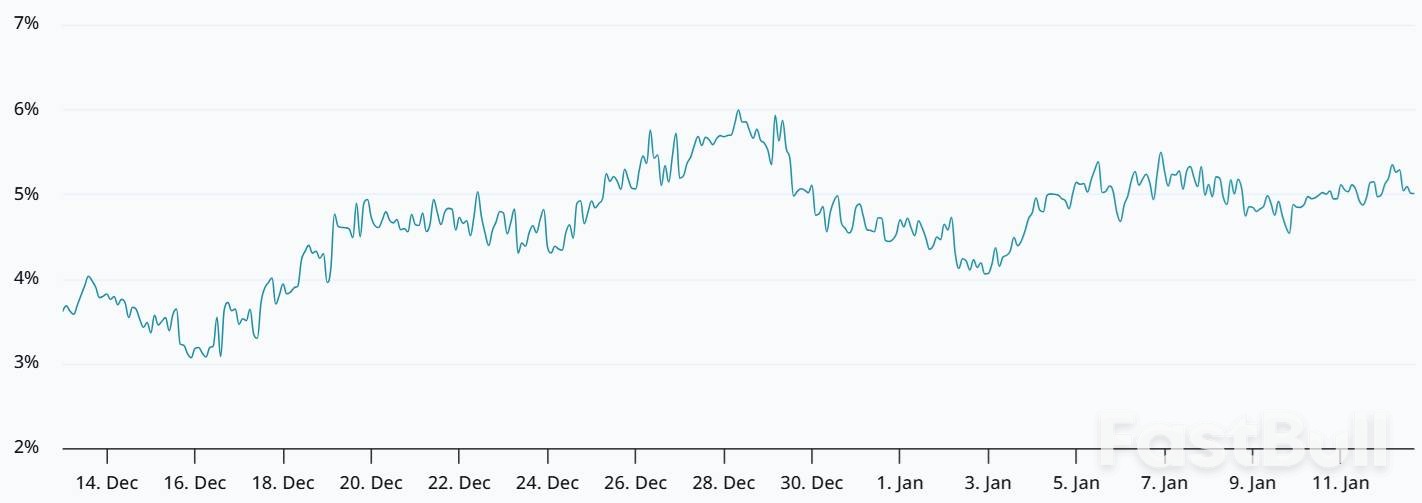
The 2-month BTC futures basis rate has hovered around the 5% mark, indicating neutral to bearish sentiment among derivatives traders.
More importantly, spot Bitcoin ETFs have seen four consecutive days of net outflows, totaling $1.38 billion. This trend is particularly concerning because Bitcoin has struggled to sustain levels above $94,000 over the past month, even with significant corporate buying. Strategy, led by Michael Saylor, announced on Monday its largest purchase of Bitcoin since July 2025, adding $1.25 billion worth of BTC to its holdings.
Strong Dollar Undermines "Debasement Hedge" Case
While Bitcoin may serve as an alternative hedge against the traditional financial system, there is little evidence that a crisis of confidence in the U.S. dollar is currently unfolding. Despite a $601 billion fiscal deficit in the final three months of 2025, U.S. government debt has maintained its investment-grade status, and yields on the 5-year Treasury have stayed below 3.8% for the past couple of months.
The U.S. Dollar Index (DXY) rebounded from its lows while the 5-year Treasury yield remained stable, suggesting no immediate flight from U.S. assets.
If traders were truly preparing for an economic downturn, the U.S. dollar would likely have weakened against other major currencies. Instead, the U.S. Dollar Strength Index (DXY) rebounded to 99 after hitting a low of 96.7 in late November 2025. This suggests that despite the strong rally in precious metals, there is no clear evidence of a widespread "debasement trade" in the market.
Ultimately, the appeal of Bitcoin and other cryptocurrencies remains subdued. The combination of heavy ETF outflows and muted demand for leveraged BTC positions suggests that the odds of a surprise rally toward $105,000 are relatively low in the near term.


