

$4,000 gold reflects ‘deeper shift in investor psychology and global capital flows’ – Saxo Bank’s Hansen
 Adam
AdamSummary:
Gold’s surge past $4,000 reflects a structural shift in investor psychology and global capital flows, driven by central-bank buying, Chinese demand, and concerns over traditional safe havens, rather than just rates or dollar weakness.
Gold’s break above $4,000 is about more than rate expectations and a weaker dollar, but reflects a deeper shift in investor psychology and global capital flows, according to Ole Hansen, head of commodity strategy at Saxo Bank.
“Gold’s relentless advance has entered uncharted territory after Asia saw the spot price break decisively above USD 4,000 per ounce for the first time, reaching USD 4,039 before stabilising - defying both a recovering dollar and renewed caution from the Federal Reserve on the pace of future rate cuts,” Hansen wrote in his latest update. “The milestone caps a year-long rally that has rewritten the market’s understanding of what drives bullion prices—and perhaps, what investors now consider ‘safe.’”
Hansen said that the move above $4,000 is not simply a function of rate expectations or a weak U.S. dollar. “Rather, it reflects a deeper shift in investor psychology and global capital flows,” he said. “In an increasingly fragmented world, the West’s weaponization of markets, payment systems, and reserve assets has eroded confidence in traditional safe havens such as the U.S. dollar and Treasuries. Sanctions, asset seizures, and concerns about fiscal sustainability have nudged investors—both institutional and sovereign—toward tangible assets that sit outside the financial system.”
He points to 2022 as the turning point, when Western sanctions froze Russia’s central bank reserves and China began increasing its gold holdings. “Central banks have since added more than 1,000 tons of gold to their reserves annually, the strongest pace on record, while high-net-worth and institutional investors have followed with renewed allocations to physical gold and bullion-backed exchange-traded funds,” he said.
“The result is a market no longer dominated by short-term speculative money reacting to real-rate moves, but by a persistent structural bid for security,” Hansen said. “The correlation that once defined gold’s inverse relationship with U.S. real yields has weakened markedly, underscoring the extent to which other forces—political, fiscal, and strategic—have taken control.”
He noted that for decades, gold mirrored U.S. real interest rates. “When inflation-adjusted yields rose, gold fell; when they fell, gold rallied,” he said. “The logic was straightforward: the metal offers no yield, and therefore competes poorly with interest-bearing assets. That framework began to fray in 2022 as the Federal Reserve’s aggressive tightening failed to break gold’s resilience.”
Even when the Fed hiked rates by 525 basis points in 17 months, gold prices did not collapse “as central-bank buying and Chinese demand offset the traditional rate-driven selling by Western asset managers.”
“In late 2022, repeated attempts to push prices below USD 1,615 failed, setting the stage for a rebound that would culminate in the March 2024 breakout above USD 2,075—a level that had capped prices for three years,” Hansen noted. “Once through that ceiling, momentum took over, reinforced by a wall of new inflows from both institutional and retail investors.”
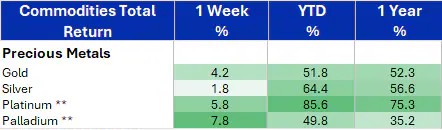
Gold has not looked back since crossing that threshold – and the other precious metals have since joined the rally. “Year-to-date gains now stand near 52%, while silver and platinum have rallied 64% and 86%, respectively,” he said. “Palladium, though less in focus, has added nearly 50%. The breadth of this move points to more than a single-asset story—it signals a rotation into tangible stores of value across the precious metals complex.”
Hansen pointed to Chinese demand – much of it driven by domestic rather than geopolitical concerns – as key to the sustained rally in gold.
“With property prices falling for the first time in a generation, Chinese households have sought alternative assets,” he noted. “Gold has become a preferred vehicle, reinforced by state media campaigns promoting its role as a safe investment. The dynamic is amplified by the structure of China’s gold market: once gold is imported, it cannot be re-exported. The result is a one-way flow—an absorption of global supply that tightens international markets and limits downside pressure.”
He pointed to tomorrow’s reopening of the Shanghai Futures Exchange after the Golden Week holiday as the next test of Chinese market sentiment.” Futures there are set to open roughly six percent higher, a move that could inject fresh momentum into global trading,” Hansen said. “The degree to which Chinese investors chase prices higher will help determine whether this rally can sustain its current pace or needs a near-term pause.”
Spot gold continues to hold comfortably above the $4,000 per ounce level on Wednesday morning, with dips only driving the price to multiple successful retests of $4,030.
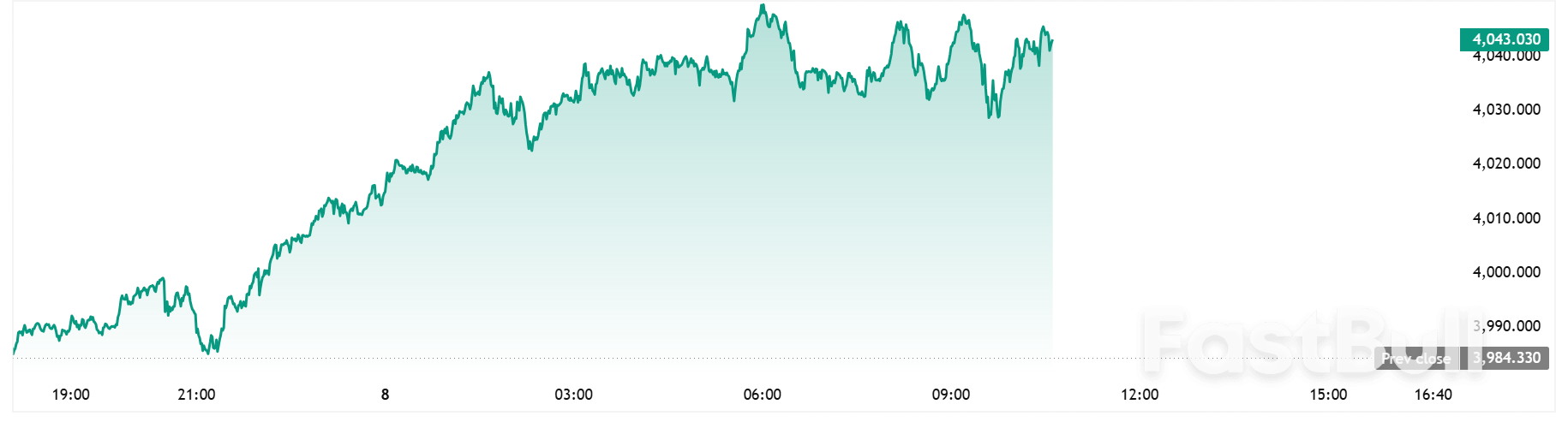
Spot gold last traded at $4,043.16 for a gain of 1.48% on the session.
Source: kitco
Copyright © 2026 FastBull Ltd
News, historical chart data, and fundamental company data are provided by FastBull Ltd.
Risk Warnings and Disclaimers
You understand and acknowledge that there is a high degree of risk involved in trading. Following any strategies or investment methods may lead to potential losses. The content on the site is provided by our contributors and analysts for information purposes only. You are solely responsible for determining whether any trading assets, securities, strategy, or any other product is suitable for investing based on your own investment objectives and financial situation.


